- 1From business center to relational infrastructure
- 2The Hive as a gateway to the district
- 3From reception to working space
- 4From front desk to community table
- 5A hybrid population of companies and individuals
- 6Workspace as a service layer within a district
- 7From space management to ecosystem activation
- 8A new role for workspace in innovation districts
- 9Conclusion
From business center to relational infrastructure
The transformation of office real estate is no longer happening building by building. It is unfolding at the scale of entire districts. MIND – Milano Innovation District – represents one of the most advanced European experiments in this direction: a place where research, corporate activity, healthcare, education and entrepreneurship converge within a single, evolving ecosystem.
Developed by Lendlease on the former Expo 2015 site, MIND is not simply a real estate project. It is a long-term platform designed to attract talent, foster innovation and enable collaboration across industries. Within this context, workspace is not an isolated asset. It becomes part of a broader system where proximity, relationships and shared infrastructure generate value.
At the center of this ecosystem sits The Hive, a 2,500 sqm business center managed by Stella33. Its role is both simple and strategic: to provide flexible, high-quality workspace solutions that allow companies of different sizes to operate inside MIND without the rigidity of traditional leases.
The Hive as a gateway to the district
The Hive operates as a point of entry into MIND. It enables organizations to establish a presence within the district without committing to large, long-term real estate investments.
This positioning is reflected in the diversity of companies that use the space. International corporates such as Glenmark, an Indian pharmaceutical company, or Nikon, coexist with Italian organizations like Bracco, Umana and LavoroPiù, alongside more niche players such as Intelligence Gastronomy, Embect and MSA Community.
Some of these companies use The Hive as a representative office. Others as a flexible operational base. Others still as a recurring meeting point for distributed teams that work remotely and need a physical place to gather on a weekly basis.
What emerges is not a homogeneous tenant mix, but a dynamic composition of users with different needs, time horizons and organizational models. The Hive is designed precisely to accommodate this variability.
From reception to working space
One of the most significant interventions carried out by Stella33 concerns the transformation of the reception area.
Traditionally, reception spaces in office buildings are conceived as transitional zones. Places of passage, often underutilized, where the primary function is control and access management. In The Hive, this logic has been completely rethought.
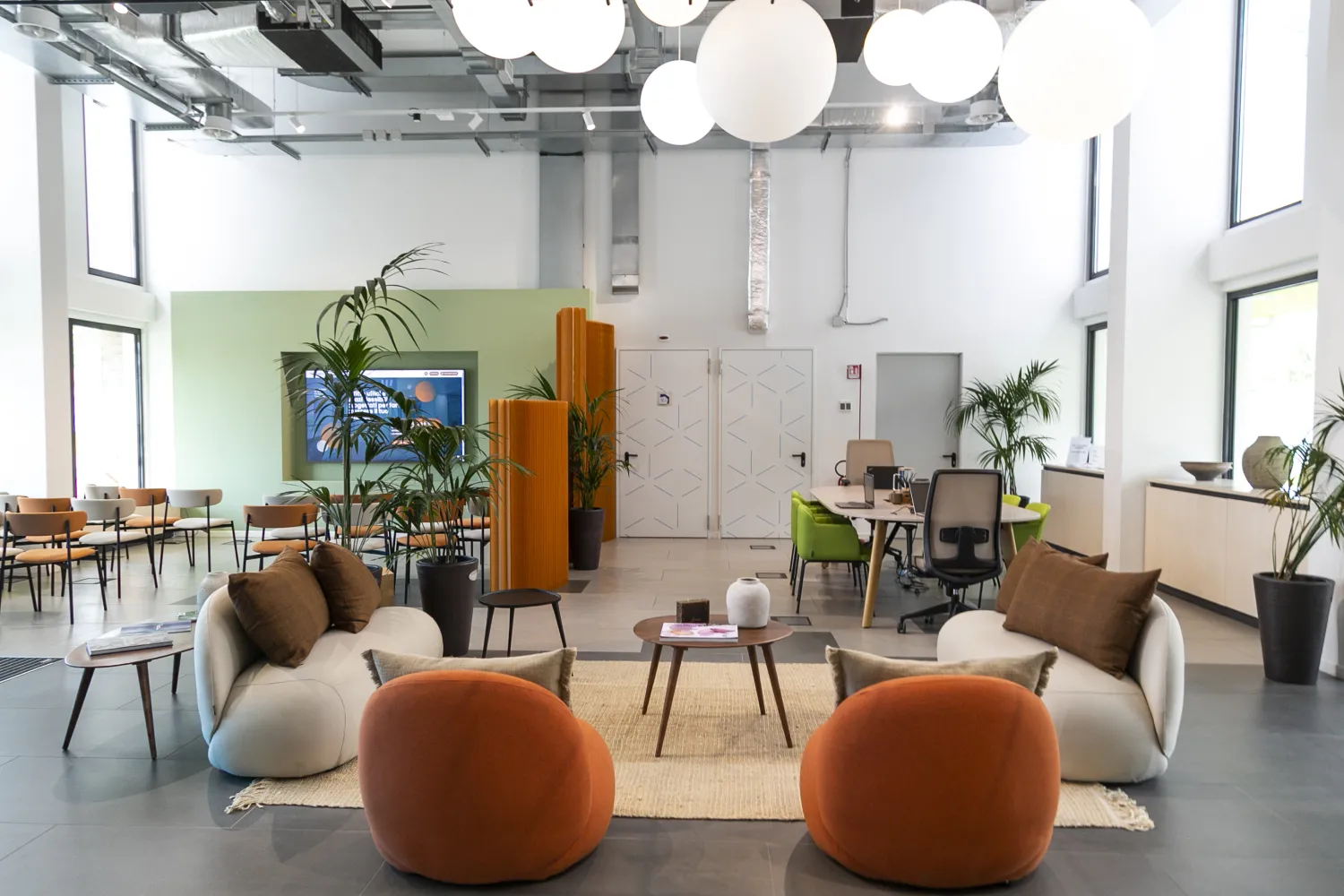
The reception has been redesigned as a living, usable space. It is now integrated with the rest of the building and connected to the meeting room ecosystem. It functions as a place for informal work, for meetups, for events and for catering activities linked to meetings.
This shift reflects a broader change in how space is perceived. Every square meter is expected to generate value. Not necessarily in terms of density, but in terms of usability, activation and contribution to the overall experience.
By transforming the reception into a working and relational environment, Stella33 has effectively increased the functional surface of the building without adding new space.
From front desk to community table
An even more profound transformation concerns the role of the people managing the space.
In the traditional model, reception is organized around a physical and symbolic barrier: the front desk. Staff operate behind the counter, separated from users, performing service functions that are often reactive and administrative.
At The Hive, this model has been replaced by a common table. The reception is no longer a boundary, but a point of connection. The people working there are no longer simply receptionists. They act as community managers and hospitality managers.
This change has both spatial and organizational implications. By removing the physical barrier, interactions become more natural and less transactional. By redefining the role, the function evolves from service delivery to community building.
The team becomes an active part of the ecosystem. They facilitate introductions, support interactions, help companies navigate the space and contribute to creating a sense of belonging among users.
A hybrid population of companies and individuals
Today, The Hive hosts around twenty companies, alongside freelancers and professionals who access the space in a flexible way.
Some organizations operate without a fixed office altogether. Their teams are distributed and work remotely most of the time. For them, The Hive becomes a recurring physical anchor. A place where teams meet, align, collaborate and reconnect.
In practical terms, this often translates into a weekly rhythm. Teams book meeting rooms, use coworking areas and spend time in shared spaces before returning to remote work.
This pattern illustrates a broader shift in corporate real estate. The office is no longer the default place where work happens. It becomes a resource that is activated when needed, particularly for relational, collaborative and strategic activities.
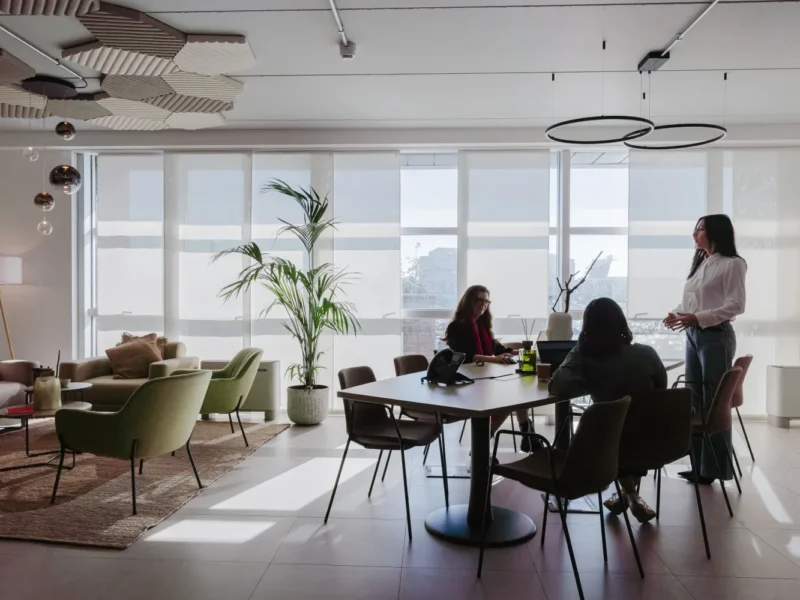
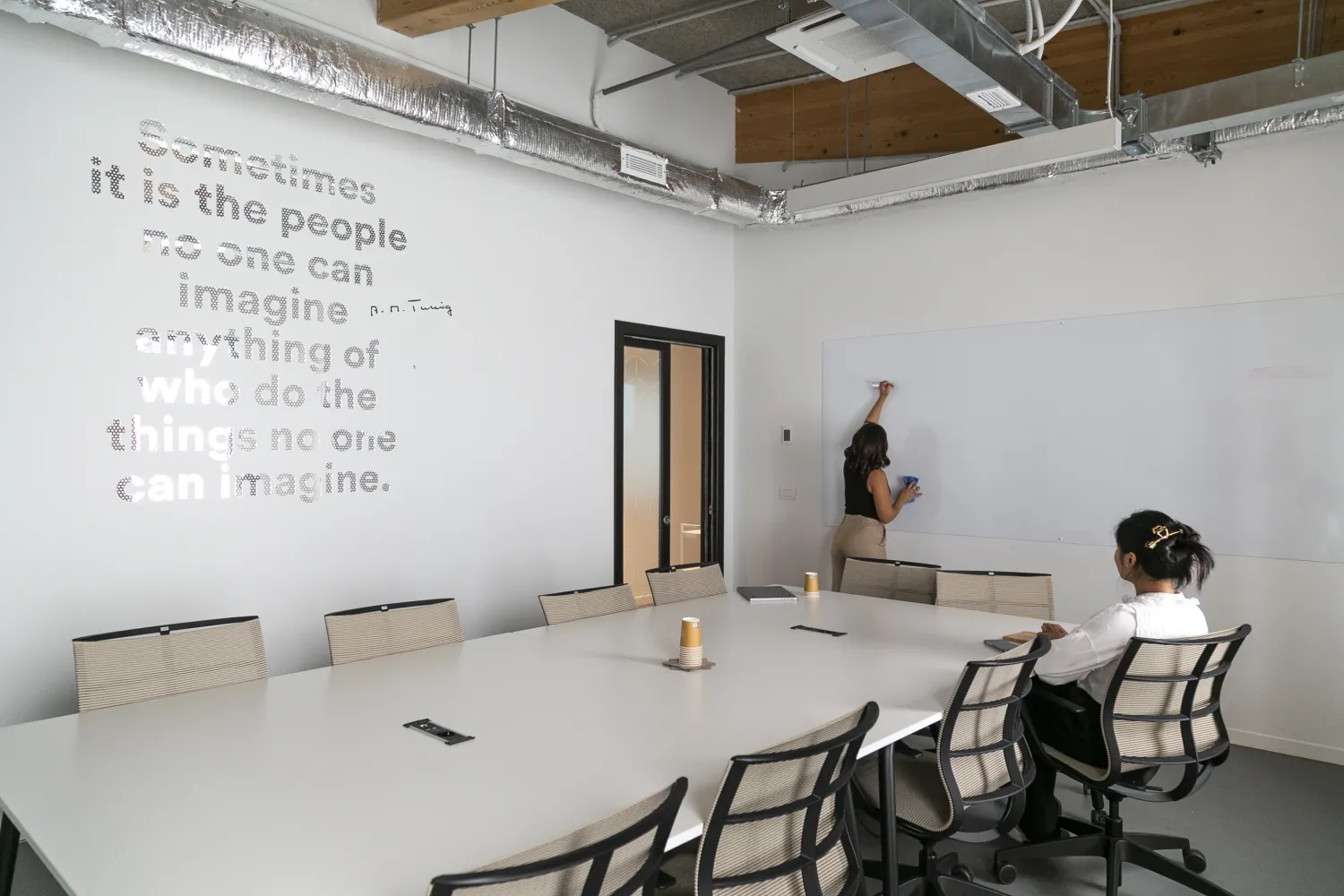
The Hive is structured to support exactly this behavior. It offers a combination of private offices, meeting rooms, shared areas and informal spaces that can be used with different levels of intensity and frequency.
Workspace as a service layer within a district
The most interesting aspect of The Hive is not any single design choice, but the role it plays within MIND.
In a district where large institutions, research centers and corporates establish long-term presences, there is a need for a complementary layer. A layer that is more flexible, more accessible and more adaptive.
The Hive provides this layer. It acts as a service infrastructure that lowers the entry barrier to the district. It allows companies to experiment, to scale up or down, to test proximity to innovation ecosystems without committing to rigid structures.
In this sense, it embodies a shift from workspace as a product to workspace as a service.
From space management to ecosystem activation
What Stella33 brings to The Hive goes beyond space management. The focus is on activation.
Activation of spaces, by making them usable, flexible and integrated. Activation of people, by fostering interactions and building community. Activation of business opportunities, by creating an environment where companies can meet, exchange and collaborate.
This approach reflects a broader evolution in the office real estate industry. Value is no longer generated solely through location, design or technical specifications. It increasingly depends on the ability to create environments where relationships can develop and where organizations can operate in a more fluid way.
A new role for workspace in innovation districts
The case of MIND and The Hive highlights a structural transformation.
In innovation districts, workspace is not just a support function. It is part of the infrastructure that enables the ecosystem to function. It connects different actors, accommodates different organizational models and provides the flexibility required by contemporary work.
For Lendlease, this means integrating real estate development with services and operational models that enhance the attractiveness of the district. For Stella33, it means redefining the role of workspace as a living system rather than a static asset.
For companies, it offers a new way to access strategic locations, manage costs and align space with actual needs.
Conclusion
The Hive at MIND is not simply a business center. It is a case that illustrates how workspace is evolving when placed inside a broader ecosystem.
By transforming reception into a living space, by redefining roles into community functions, and by enabling flexible access to high-quality environments, Stella33 has contributed to turning a building into a platform.
And within MIND, this platform plays a critical role: it makes the district more permeable, more dynamic and more aligned with the realities of contemporary work.
In this sense, the future of office real estate may not be about choosing between traditional offices and flexible spaces. It may be about designing systems where both coexist, connected by infrastructures like The Hive, capable of adapting to organizations that are themselves becoming more fluid.