- 1Intro
- 2Why CFOs Need a New Framework for Office Real Estate Costs
- 3What is the Economic Efficiency Score (EES)
- 4How the Economic Efficiency Score Works
- 5The CFO Checklist: What You Should Be Measuring
- 6Cost Mapping: The Hidden Layer of Workspace Economics
- 7Key Outputs: What the EES Reveals
- 8From Cost Reduction to Value Optimization
- 9Typical Scenarios Identified by the EES
- 10Strategic Implications for Corporate Real Estate
- 11Why the EES Matters Now
- 12Start Your Workspace Cost Assessment
- 13Discover your Economic Efficiency Score
From Cost Center to Strategic Infrastructure
Intro
For decades, corporate real estate has been managed as a relatively static cost line: rent, operating expenses, initial investments, and limited visibility over what happens over time. That paradigm no longer holds.
The workspace has become one of the most complex infrastructures to manage within organizations. Hybrid work models, fluctuating occupancy, cost pressures, and evolving employee expectations have transformed the office from a stable asset into a dynamic system.
In this context, a critical issue emerges:
most companies do not truly know how much their office costs, nor how much value it generates.
The Economic Efficiency Score (EES) is designed to address this gap. It is not a simple financial metric, but a structured framework that enables organizations to understand, govern, and optimize the real cost of their workspace.
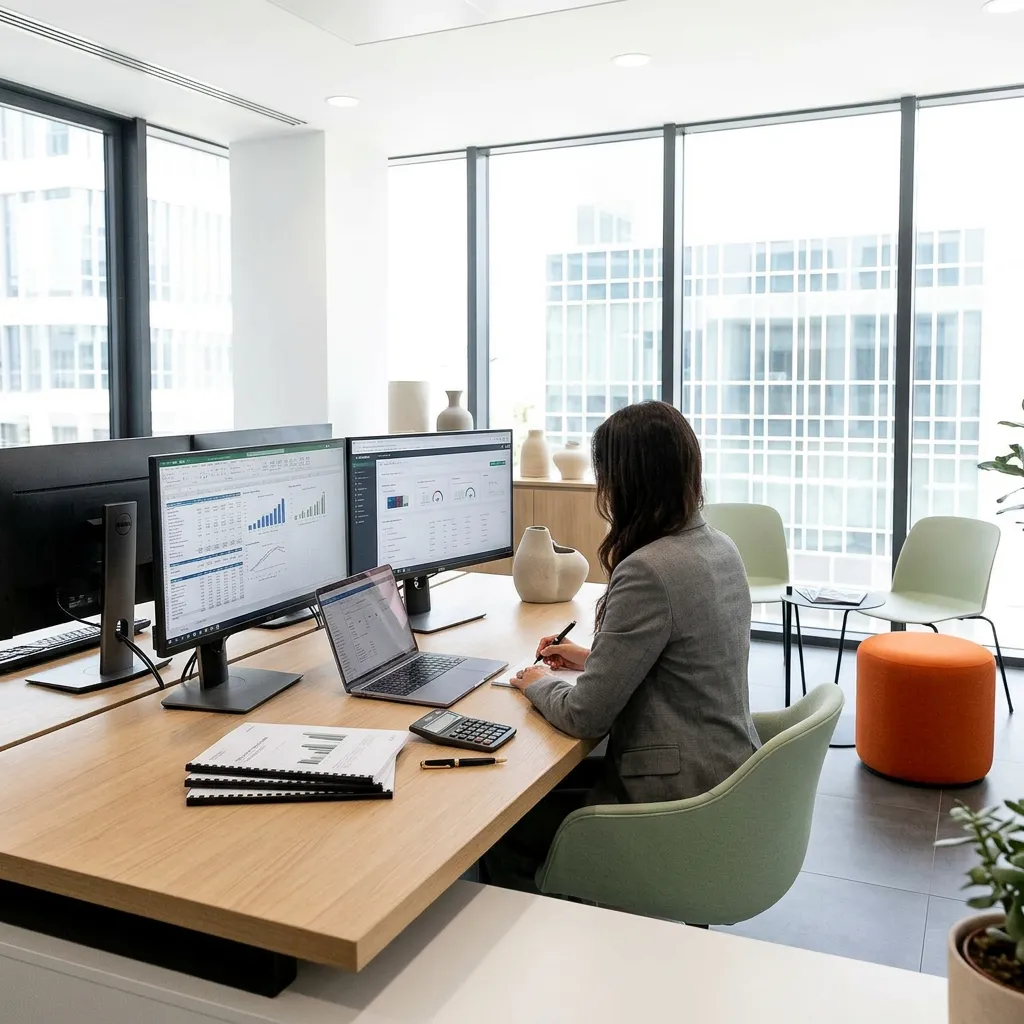
Why CFOs Need a New Framework for Office Real Estate Costs
Within the corporate P&L, office-related costs are often among the largest after personnel. Yet, unlike other functions, corporate real estate suffers from three structural weaknesses.
First, data fragmentation. Costs are distributed across rent, facilities, technology, services, HR, and indirect expenses. Rarely are they consolidated into a single, coherent view.
Second, the disconnect between cost and utilization. Many companies still operate with footprints designed for full occupancy, despite significantly lower real usage driven by hybrid work.
Third, the invisibility of hidden costs: operational inefficiencies, time spent on non-core activities, turnover influenced by workplace quality, and underutilized space.
For a CFO, this leads to a fundamental problem: decisions are often made based on incomplete information.
The EES introduces a different perspective. It does not ask how much the office costs, but how well it is governed, how efficiently it is used, and how aligned it is with business needs.
What is the Economic Efficiency Score (EES)
The Economic Efficiency Score is a proprietary index that measures the economic efficiency of a company’s workspace.
Rather than focusing solely on cost levels, it evaluates three key dimensions:
- the quality of cost governance
- the transparency and readability of the cost structure
- the alignment between cost, usage, and value generation
The result is a score from 0 to 100, providing a clear and comparable snapshot of the organization’s position.
Unlike traditional real estate analysis, the EES is not a technical audit. It is a management tool designed to highlight inefficiencies, uncover blind spots, and support strategic decision-making.
How the Economic Efficiency Score Works
The EES is built on two integrated layers.
The first layer evaluates the core economic logic of the workspace: how clearly costs are understood, how consistently they are monitored, how aligned they are with actual usage, and how flexible the cost structure is.
The second layer measures the depth of cost governance, assessing how well the organization understands and manages all categories of workspace-related costs, including indirect and often overlooked components.
This dual structure allows a clear distinction between companies that simply manage costs and those that actively govern their workspace as a system.
The outcome is not just a score, but a structured diagnosis.
The CFO Checklist: What You Should Be Measuring
To fully understand the cost of corporate real estate, a CFO should be able to answer a set of critical questions.
How clear is your Total Cost of Occupancy, including not only rent but also services, technology, and indirect costs?
How much of your workspace is actually used, and how does that compare to your total footprint?
What proportion of your costs is fixed versus variable?
To what extent do hidden inefficiencies impact your overall cost structure?
Is there clear ownership and governance of workspace-related decisions?
The EES translates these questions into a structured model, enabling an objective and comparable assessment.
Cost Mapping: The Hidden Layer of Workspace Economics
One of the defining elements of the EES is its comprehensive cost mapping approach.
The analysis extends beyond direct real estate costs to include:
- operational costs such as utilities, maintenance, and services
- technology-related costs including IT infrastructure and digital tools
- organizational and indirect costs such as internal time and inefficiencies
- capital expenditures including fit-out, furniture, and upgrades
- opportunity costs such as underutilized space, lack of flexibility, and missed optimization opportunities
This expanded perspective reveals a critical insight:
the real cost of the office is significantly higher than what is typically perceived.
Key Outputs: What the EES Reveals
The Economic Efficiency Score does not produce a single number, but a set of interconnected insights.
The primary output is the overall score, representing the level of economic efficiency.
Alongside this, the Cost Governance Index measures the depth of cost awareness and control across categories.
The Hidden Cost Exposure indicator highlights the extent to which indirect and opportunity costs remain unmanaged or invisible.
These outputs are supported by visual tools designed for clarity and immediate interpretation:
a cost awareness heatmap showing the level of knowledge across cost categories,
a radar chart highlighting imbalances between governance, utilization, and flexibility,
a positioning matrix mapping the organization’s efficiency versus its level of control.
The value lies not in analytical complexity, but in making the invisible visible.
From Cost Reduction to Value Optimization
A common mistake is to approach workspace purely as a cost reduction exercise.
Leading organizations are adopting a different mindset. They are not focused on spending less, but on spending better.
This involves:
aligning costs with actual usage,
introducing more flexible cost structures,
reducing hidden inefficiencies,
and transforming the workspace into a driver of performance.
In this context, the EES becomes a tool not just for optimization, but for strategic repositioning.
Typical Scenarios Identified by the EES
The EES framework consistently reveals recurring patterns.
Some organizations show relatively controlled costs but limited visibility into indirect expenses, leading to underestimation of the real cost base.
Others demonstrate strong governance but a significant mismatch between cost and actual utilization, often due to rigid real estate structures.
In more critical cases, both visibility and efficiency are low, creating systemic inefficiencies that impact financial performance.
These scenarios are not exceptions. They reflect the current state of the market.
Strategic Implications for Corporate Real Estate
The key takeaway is clear:
the issue is no longer how much the office costs, but how governable it is.
As work becomes more distributed and dynamic, the complexity of workspace management increases. With it, the need for structured tools and frameworks becomes essential.
For landlords and operators, this implies a shift toward more flexible, service-oriented models.
For companies, it means repositioning corporate real estate as a performance lever rather than a fixed constraint.
Why the EES Matters Now
Hybrid work has exposed a fundamental contradiction:
organizations have changed how they work, but not how they manage space.
This creates structural inefficiencies that cannot be addressed through incremental adjustments.
A new approach is required.
The Economic Efficiency Score represents that shift:
from passive management to active governance,
from fragmented visibility to integrated understanding,
from opaque costs to measurable systems.
Start Your Workspace Cost Assessment
Understanding your Economic Efficiency Score is the first step toward rethinking the role of workspace within your organization.
This is not only about cost optimization, but about building a foundation for better decisions.
Today, the workspace is no longer an invisible infrastructure.
It is a lever that directly impacts cost, performance, and competitiveness.
Measuring it correctly is the first step to managing it effectively.
Discover your Economic Efficiency Score
Start your Workspace Health Assessment and understand how your office truly performs

Try our tool
Economic Efficiency Score (EES): The CFO’s Framework for Managing Office Real Estate Costs