A conversation with Guido Ferraresi (DILS) on how occupier demand is reshaping the market
Introductory synthesis
The conversation with Guido Ferraresi offers a clear snapshot of the current state of office real estate in Italy: a market that is not shrinking, but rapidly polarizing around quality, location, and the ability of spaces to attract people.
Demand is no longer driven by purely functional logic, but by deeper objectives: talent attraction, brand positioning, and alignment with the organizational model. In this context, the office evolves from a real estate asset into a true destination.
Two dynamics emerge with particular clarity.
On one side, the centrality of location as the primary lever in occupier decisions: no longer just prestigious addresses, but accessible urban ecosystems, rich in services and capable of supporting people’s daily lives. On the other, a structural transformation of space, moving toward more efficient, hybrid and collaboration-oriented models.
The Italian market reflects global trends, but with its own specificity: a strong concentration on Milan and a growing gap between demand and the availability of high-quality product. The result is an increasingly sharp polarization between attractive assets and obsolete stock, with direct implications on values, rents and investment strategies.
In the background, a deeper theme emerges: space is no longer a container, but an active component of the organizational system, capable of influencing performance, relationships and the ability to attract talent—as also highlighted by the most recent industry analyses.
Interview
Pietro Martani: Guido, let’s start with the most immediate question: which locations are truly in demand today, and by which types of companies?
Guido Ferraresi:
Demand has now clearly stabilized around locations that help bring people back to the office. This means central or semi-central areas, well connected to metro lines and stations, within regenerated urban contexts rich in services. It is no longer just about having a prestigious address.
At a European level, in stay-or-go decisions, the primary driver is the quality of the location, and only secondly the quality of the building.
In Milan, the most sought-after submarkets remain the CBD and Porta Nuova, but we are also seeing strong interest in major urban regeneration clusters such as CityLife and Scalo di Porta Romana, which combine iconic architecture with a high-quality user experience.
In Rome, demand continues to focus on the CBD, the historic center and EUR Core, but here the issue is even more evident: there is a shortage of quality product. In 2025, around 42% of transactions involved Grade A/A+ buildings, a clear sign of increasing selectivity.
The companies driving this demand are those most exposed to competition for talent and positioning: professional services, legal, finance, tech, corporate headquarters and international organizations.
Pietro Martani: From a space perspective, what type of office are companies looking for today?
Guido Ferraresi:
Here again, we see a clear polarization.
Medium to small companies, below 5,000 sqm, are often increasing their footprint. This is driven by two factors: a more structured return to the office—often four days out of five—and the need for more space dedicated to collaboration and client interaction.
Larger companies, above 5,000 sqm, are following a different logic: fewer square meters, but better ones.
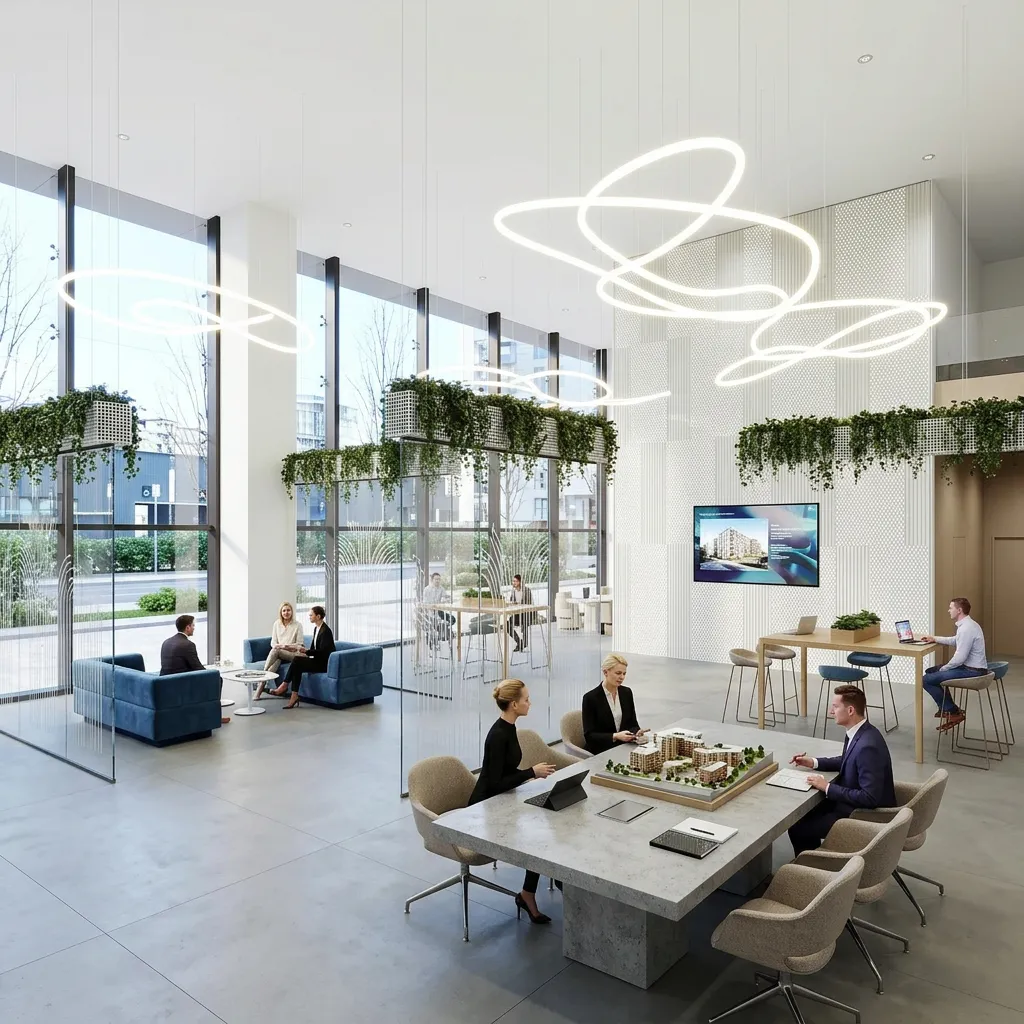
The prevailing model is based on higher efficiency, hybrid layouts with fewer assigned desks, and a significant increase in spaces dedicated to collaboration, meetings, social interaction and focus.
So it is not simply about reducing space, but about redesigning it according to how people actually work.
Pietro Martani: Let’s move to services: what are end users looking for today?
Guido Ferraresi:
User expectations are becoming increasingly standardized. Reception and meeting rooms are no longer enough. The office needs to become a destination.
Recurring requirements include locations aligned with the company’s positioning, strong accessibility via public transport, the presence of food & beverage and daily services, meeting and event spaces, as well as a growing focus on wellness and environmental comfort.
Ultimately, companies are looking for what cannot be replicated at home: an ecosystem that enables relationships, experience and quality of work.
Pietro Martani: How does the demand–supply gap currently look across Italy?
Guido Ferraresi:
In Milan, the gap is very clear, but not in purely quantitative terms. It is a qualitative and locational gap.
Demand for Grade A/A+, sustainable and well-located buildings is extremely strong, but prime supply is very limited. In the most sought-after submarkets, vacancy is around 1%, which is pushing prime rents up to approximately €850 per square meter per year.
In Rome, the dynamic is similar, but with less overall market momentum. Here too, however, the shortage of premium product remains a key issue.
Across the rest of Italy, the situation is more fragmented. Cities such as Turin, Bologna, Florence, Naples, Bari and Catania show interesting potential, but the gap is twofold: on one side, there is very limited institutional-grade supply; on the other, international corporate demand remains intermittent and tied to specific projects.
Pietro Martani: Can we say that Italy is following global trends?
Guido Ferraresi:
Yes, broadly speaking, with a slight delay and a strong concentration on Milan.
Global trends are now well defined: demand for central and well-connected locations, a structurally embedded hybrid model with more focus on actual office presence, the growth of flex office solutions, and increasing conversions into other asset classes.
Italy is moving in the same direction, but with a more gradual pace.
Pietro Martani: Final question: on the investment side, what has changed and what should we expect in the coming years?
Guido Ferraresi:
Since 2020, investment strategies have clearly polarized along two main directions.
On one side, strong interest in core and core+ prime assets, particularly those that are central, ESG-compliant, liquid and with high tenantability.
On the other, there is growing interest in value-add and repositioning strategies, but with a highly selective approach: retrofit must genuinely close the quality gap and make the asset competitively leasable.
Looking ahead, we will likely see further cap rate compression for prime assets, increasing polarization between modern buildings and obsolete stock, more retrofit and conversion projects, and a growing focus on capex, energy compliance and location quality.
Conclusion
Ferraresi’s perspective confirms a trajectory that is now increasingly evident: the office market is not contracting, but transforming.
Demand selectivity, the centrality of location, and the growing integration between space, services and organization are redefining value drivers. In this scenario, the real distinction is no longer between more or fewer square meters, but between spaces that attract and spaces that remain empty.
And it is precisely within this polarization that the future of office real estate will be defined.
DILS
Born from the transformation of a historic Italian real estate advisory brand, DILS has established itself as a leading player in the sector. Today, it competes with major international firms in the Italian market, standing out for its agility, deep local knowledge, and its ability to manage complex transactions across key segments: offices, logistics and capital markets.
Understand how your workspace performs.
Explore the Workspace Alignment Index and discover where value is created—or lost.