Designing Intentional Work Environments: From Invisible Skills to Performance
There is a paradox at the heart of contemporary work. We invest years in education, accumulate technical knowledge, and specialize in sophisticated domains, yet almost no one teaches us how to work effectively. Not how to collaborate, manage attention, navigate organizational dynamics, or design intentional work environments for sustained performance. We enter companies equipped with execution tools but without a framework for real effectiveness.
Organizations try to compensate through cultures, rituals, and processes. But these are often implicit and inconsistent. The result is structural inefficiency: individuals learn by trial and error, teams constantly reinvent norms, and performance depends more on context than capability.
In today’s knowledge economy, where value comes from interaction, cognition, and creativity, designing intentional work environments has become critical. The central question is no longer just how we work — but who designs the conditions under which work happens.
Three Thinkers Who Reframed How We Work
To understand what “working well” means, three foundational perspectives stand out:
Peter Drucker – The Knowledge Worker as Self-Manager Peter Drucker was among the first to argue that in knowledge work, productivity depends on individuals managing themselves. Time, attention, and priorities become strategic resources. Effectiveness is about choosing what matters most.
Amy Edmondson – Psychological Safety as a Performance Driver Harvard professor Amy Edmondson showed that the best teams are not the most talented, but those with high psychological safety — where people feel safe to contribute, challenge ideas, and learn from failure. This turns collaboration into a real performance advantage.
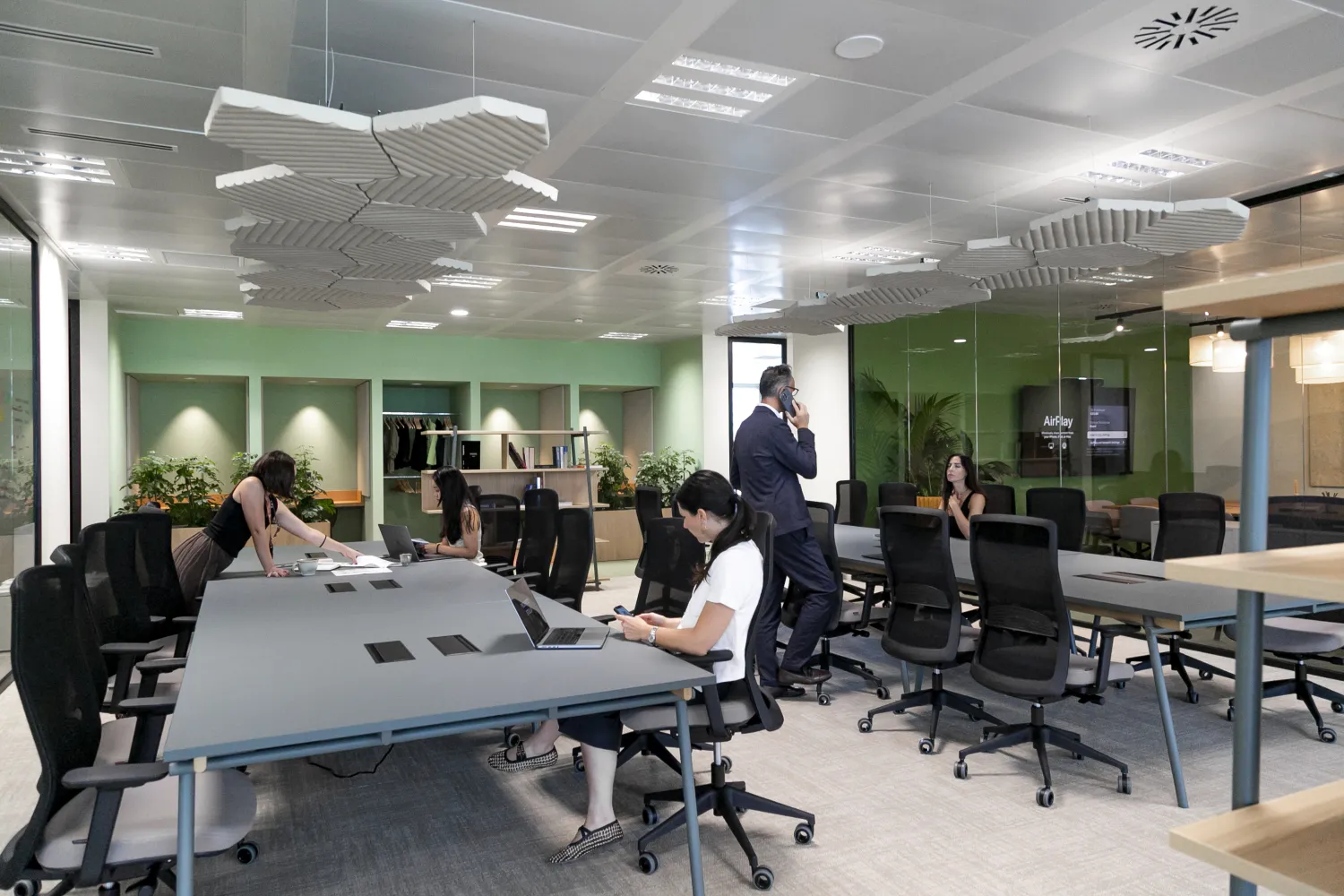
Jeremy Myerson – Activity-Based Working and Spatial Intelligence Through his pioneering work on Activity-Based Working (ABW), Jeremy Myerson demonstrated that work is not one single activity and cannot thrive in one single type of space. Aligning physical spaces with different modes (focus, collaboration, learning, social interaction) significantly improves productivity and satisfaction. Today, over 70% of new corporate offices incorporate advanced ABW principles.
The Invisible Infrastructure of Effectiveness
Combining these views reveals that designing intentional work environments requires alignment across three dimensions:
- Individual behavior: How we manage time, energy, and cognitive load
- Organizational culture: How we interact, decide, and build trust
- Physical environment: Where and how work actually takes place
Most companies optimize only one dimension. The most successful organizations intentionally design all three together. The modern office is no longer a place of control — it is a platform for performance, culture, and wellbeing.
Wellbeing Is a Performance Variable
Research from Harvard and the journal Building and Environment confirms that better air quality, ventilation, and natural light directly improve cognitive function, decision-making, and energy levels. Organizations that neglect environmental quality are not just affecting wellbeing — they are leaving measurable performance on the table.
From Place to System: Designing Your Own Way of Working
In the absence of formal training on “how to work,” both individuals and organizations must become active designers:
For individuals:
- Understand when and where you do your best work
- Master cognitive load and interruptions
- Build strong relationships within teams
For organizations:
- Define when physical presence creates real value
- Create varied spaces that support different work modes
- Build cultures that reward contribution over compliance
The Real Question Is Not Where We Work, But How
The remote vs. office debate often misses the point. The real issue is capability: Do people know how to structure their work? Do teams know how to collaborate? Do organizations know how to design intentional work environments that support both?
With these capabilities in place, almost any model (remote, hybrid, or office-first) can succeed.

Conclusion
We have entered an era where work is defined by design rather than location. Making the discipline of “how to work” explicit — through better self-management, psychological safety, and intentional work environments — is one of the greatest opportunities for individuals and organizations today.
Performance is no longer just a function of talent or effort. It is the outcome of a well-designed system.