A conversation between Pietro Martani and Stefano Carone (ilPrisma) on workspace, employer branding, and why the office still matters
This is one of those questions that runs through everything we do at Limitless Workspace: why should people choose to go to the office? And what must a space do to deserve that choice? Pietro Martani discusses this with Stefano Carone, founder of ilPrisma, a Milan-based architecture studio that has spent years designing workplaces as relational systems, not as functional containers.
Pietro Martani — Stefano, let’s start with a provocation. CBRE’s 2026 data tells us that average global office occupancy has reached 53 percent—the highest since the pre-pandemic era. 96 percent of organizations now have formal attendance policies. And yet the real question remains unanswered: why come to the office? I put it this way—if the only reason to show up is a corporate mandate, you’ve already lost.
Stefano Carone — You’ve already lost, yes. And the answer doesn’t lie in the policy or in the layout. It lies in the experience. When we design a workspace, we’re not designing an office: we’re designing what happens between the people who move through it. Interactions, dynamics, learning, rituals. That’s where everything is at stake. If the space doesn’t activate any of that, it’s a container. And a container isn’t worth the commute.
Pietro Martani — That aligns closely with what the data shows. The Gensler Global Workplace Survey 2025 found that employees who report a great workplace experience are 3.6 times more likely to believe their office helps attract talent. It’s not the ping-pong table—it’s the system. But how do you translate that idea into actual design practice? Because it’s easy to say and much harder to do.
Stefano Carone — Our approach starts from a clear premise: space as a contributor. It’s not a passive backdrop. It’s an active element that contributes to the organization’s mission. And there’s no single recipe for getting there—there’s a method: observe, listen, involve. We run co-design processes with organizations. Workshops with key stakeholders, observation of real dynamics, analysis of needs across different practices. Because the risk is always the same: designing the space the CEO wants, not the one people actually need.
Pietro Martani — That’s a critical point. In the Limitless Workspace booklet we noted that only 15 to 16 percent of organizations invest in training managers and employees on hybrid work practices, despite everyone agreeing it would make a difference. There’s a massive gap between what’s declared and what’s actually done. And workspace isn’t immune—you can design the most sophisticated Activity Based Working environment in the world, but if the organizational culture doesn’t support it, people will stay glued to the same desk.
Stefano Carone — Exactly. Culture is the prerequisite. We see it in every project: when the organization is mature, space amplifies. When it’s not, space risks becoming an empty manifesto. That’s why co-design isn’t a luxury—it’s the way to surface the real culture and design from that, not from the version in the company deck.
Havas: when space tells the story of change
Pietro Martani — Tell me about Havas. I find it a compelling case: a communications agency rethinking its headquarters not as a move but as a strategic act.
Stefano Carone — That’s exactly what it was. We had to imagine a space capable of narrating and activating the agency’s transformation. Not a new office, an ecosystem. An environment that functioned simultaneously as a workplace, a creative hub, a meeting point with the city, and a system of internal and external relationships. We started with workshops involving key people from the agency, observed their working dynamics, and analyzed the needs of their different practices. The project was born from that process.
Pietro Martani — What strikes me is the idea of permeability with the city. At Limitless Workspace, we talk a great deal about multi-tenancy, about ecosystems where large corporations, startups, and freelancers coexist and cross-pollinate. The notion that an organization’s space is not a fence but an interface is powerful. In your experience, did Havas actually live that, or did it remain aspirational?
Stefano Carone — They lived it. And the reason is that openness was coherent with their business model. Havas integrates creativity, data, and diverse competencies. If your working model is convergence, the space must enable convergence, not isolate people in silos. Internal pathways, liminal spaces, those in-between zones of passage and transition, were designed as opportunities for informal encounters, for exchange across disciplines. Movement becomes experience. And the dialogue between architecture and brand is real: the space interprets and makes visible the company’s values. Openness, connection, innovation. The workplace becomes an identity language.
Pietro Martani — And what about employer branding?
Stefano Carone — Employer branding is built through the experience of the space. It’s not the slogan on the wall. It’s the fact that when you walk into that environment, you understand who Havas is, how they work, what they value. Environments that foster interaction across teams, fluid access to resources, quality in the daily experience, these reinforce corporate identity and directly affect the ability to attract and retain talent. The workspace becomes a concrete lever in the relationship between organization and people. It’s not a perk. It’s infrastructure.
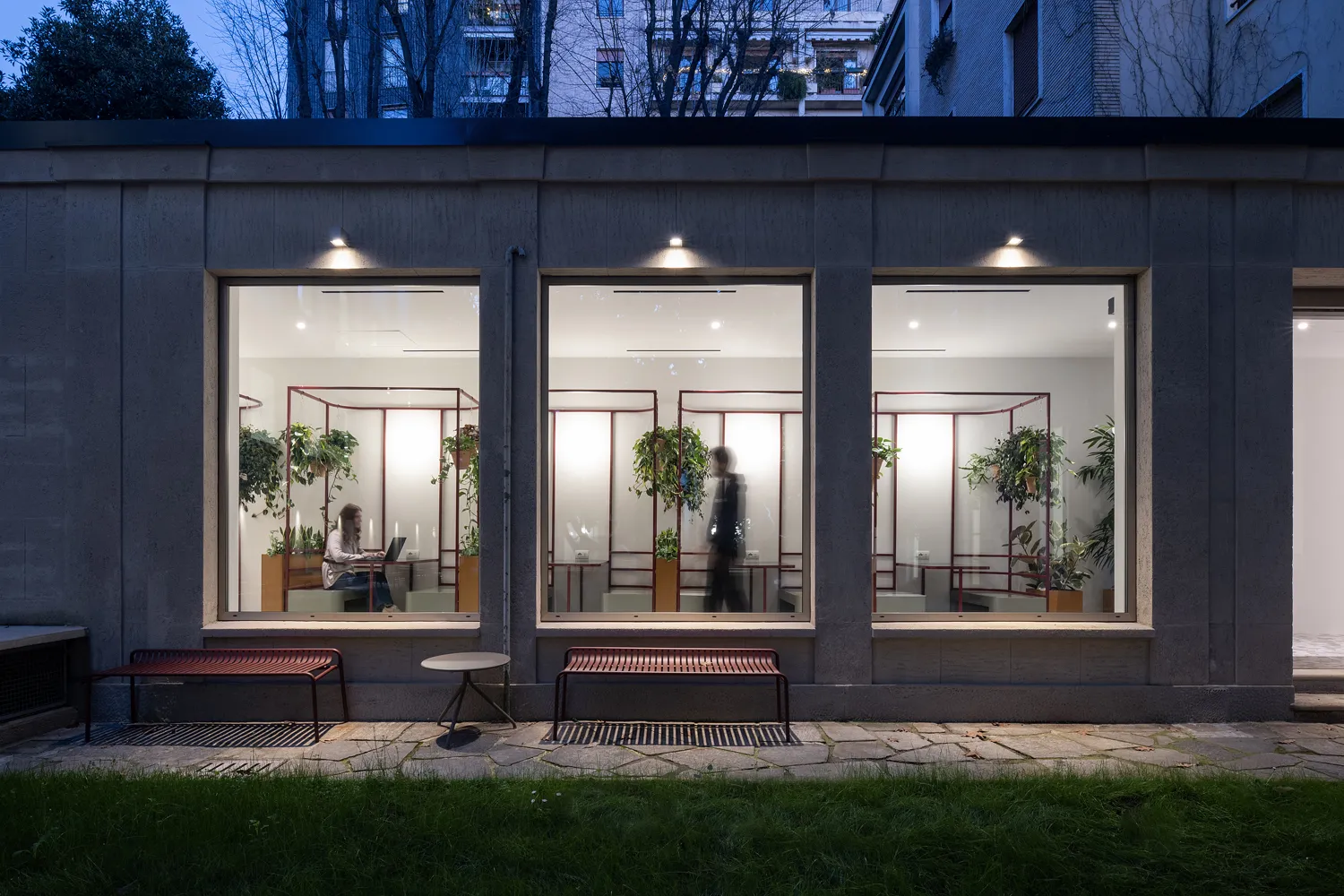
Acqua di Parma: rituals as a design matrix
Pietro Martani — The other case is Acqua di Parma, which is very different. Here we’re not talking about creative convergence but about an exceptionally strong brand heritage. How do you enter that territory as a designer?
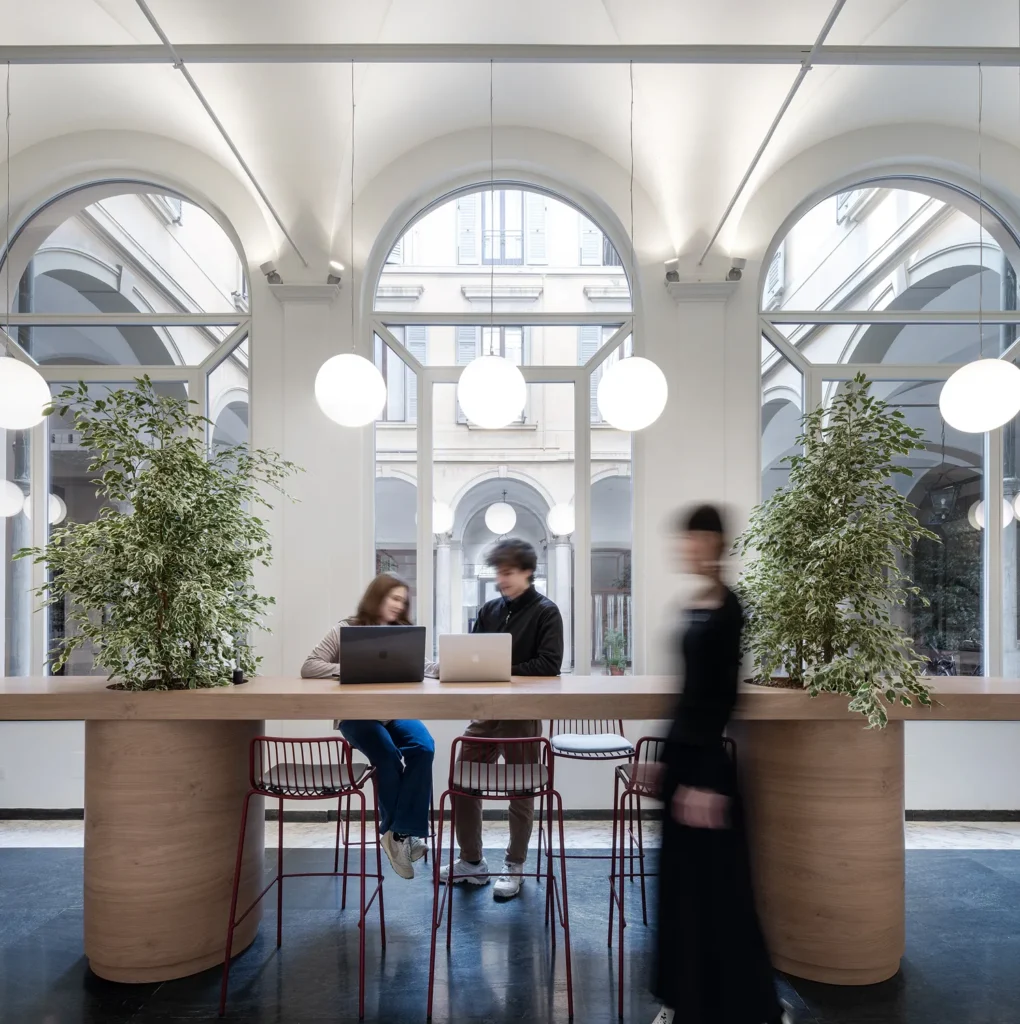
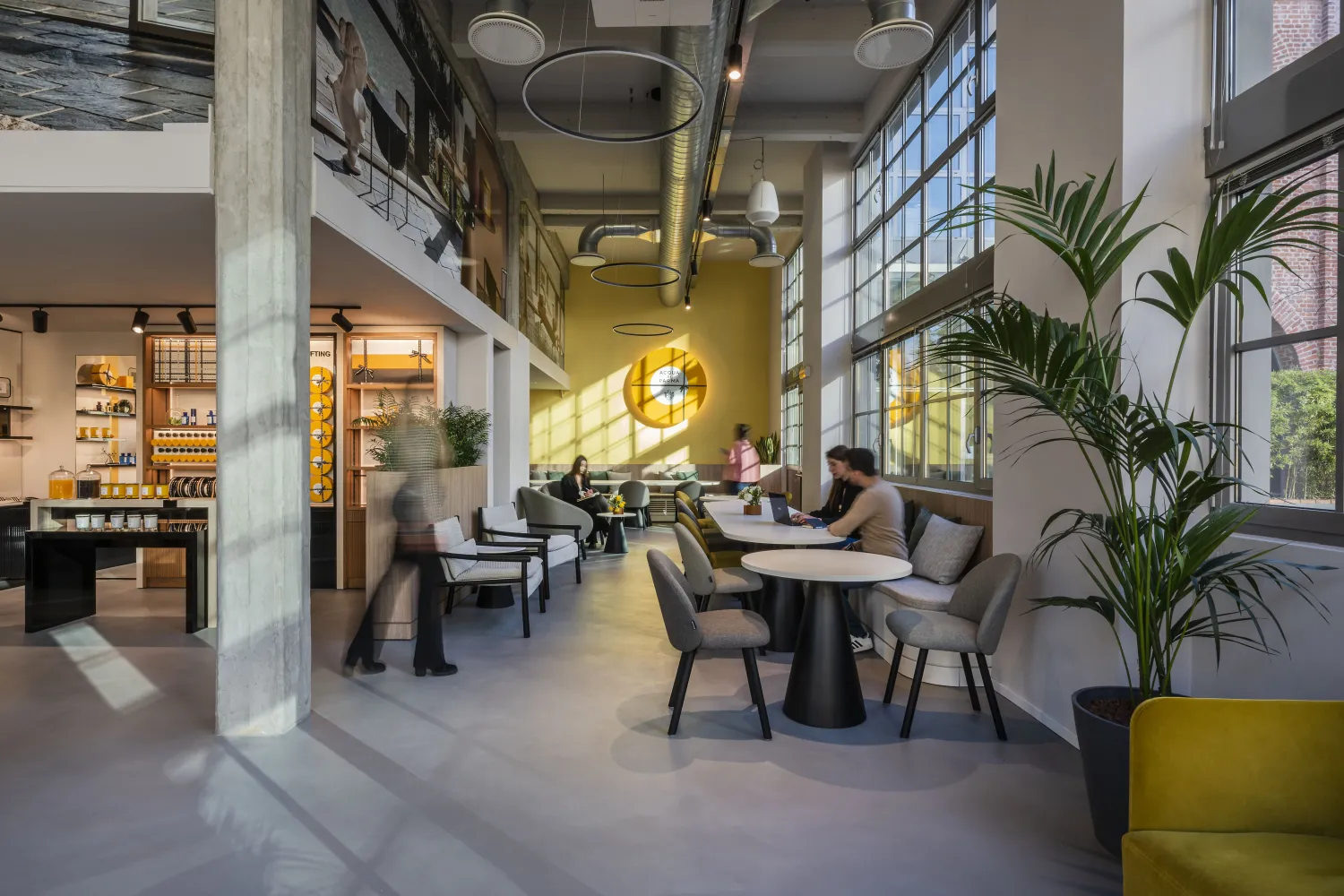
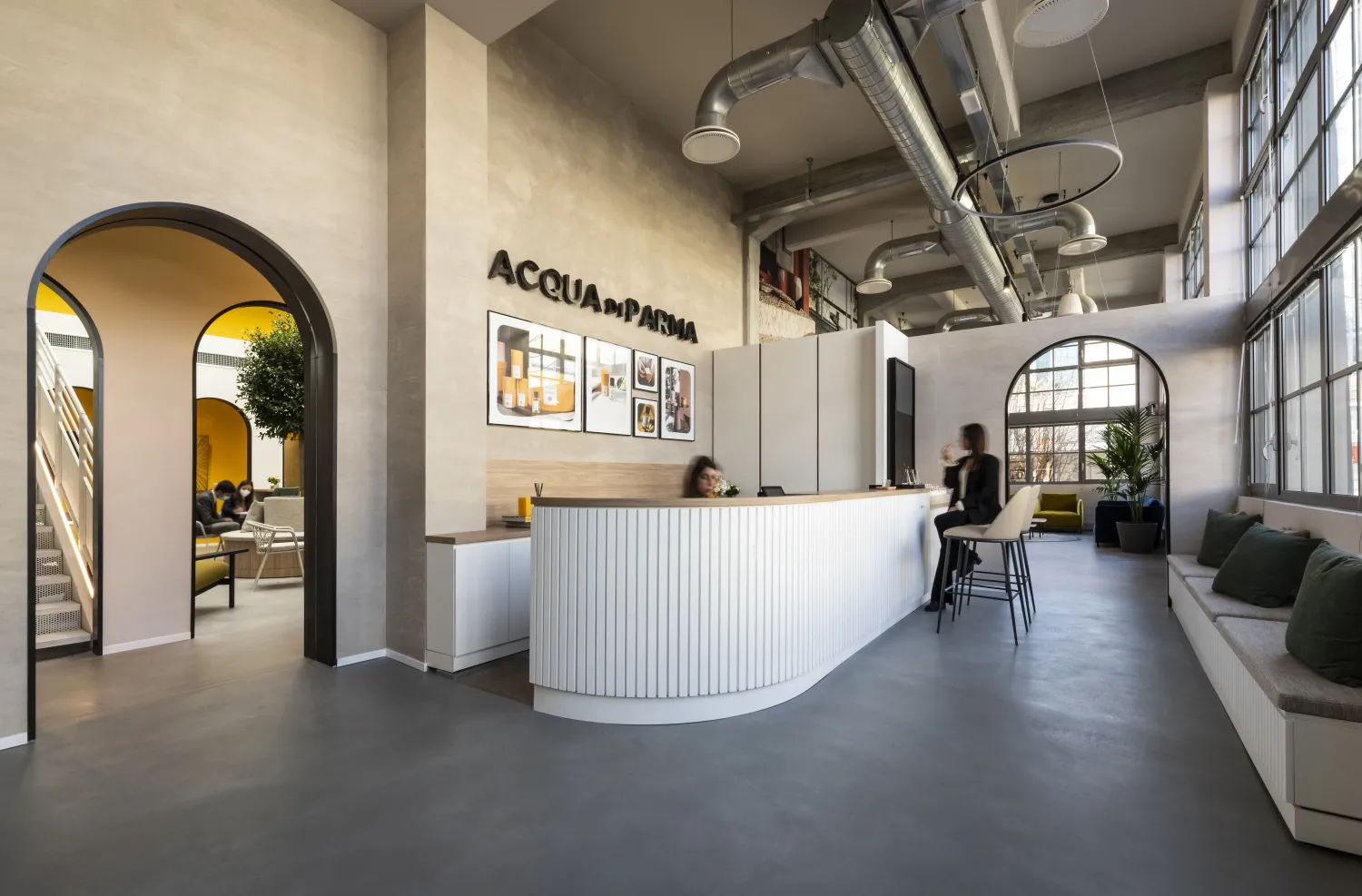
Stefano Carone — You enter through rituals. And not just work rituals, the ones that define the brand experience and its imagination. Acqua di Parma is conviviality, beauty, relationship. That’s where we started. We integrated operational rituals, how people work, meet, make decisions, with brand rituals, how the brand tells its story, reveals itself, is lived. The goal was to build an environment that could function both as a workspace and as an immersive experience.
Pietro Martani — The concept of ritual applied to workspace is underexplored and, in my view, extremely powerful. We talk about Activity Based Working, where people move between different settings based on the task at hand. But ritual adds a layer: it’s not just what you do and where, but how and with what meaning. It’s the shift from function to sense.
Stefano Carone — Precisely. At Acqua di Parma, we translated this into a sequence of environments and moments. The reference to the Italian piazza, for instance, became a central space dedicated to sociality and relationship-building. The ritual of discovery became a progressive experience of the place, where the brand reveals itself through pathways, materials, and interactive elements. The rituals aren’t merely evoked: they’re embedded in the space, becoming an active part of daily experience. The workplace becomes an identity device.
Pietro Martani — Identity device is a strong term. It makes me think of something: when space succeeds in conveying identity, it stops being a commodity measured by the square meter. This has enormous implications for real estate, we discuss it extensively in the supplement. The value of a building is no longer just in the lease. It’s in the experience it enables.
Stefano Carone — And that’s the point landlords need to understand. If space produces belonging, strengthens culture, and helps attract talent, then its value to the organization far exceeds the cost of rent. And for the owner, it becomes a more defensible asset, more stable, more attractive to other tenants.
Space as relational infrastructure
Pietro Martani — One final question. Technology has taken enormous leaps and with generative AI, it will take more. There are those who say work can happen anywhere, that the metaverse solves everything, that the physical is a relic. What do you say?
Stefano Carone — That technology has made extraordinary strides, but it doesn’t reach the quality of relationships built in the physical world. Strong, stable, deep bonds are formed through presence. Not through a screen. The office remains irreplaceable in this regard: not as an operational space that can be anywhere, but as an experience. Designing the work experience means giving people a reason to be present. When space manages to do that, it contributes to the quality of work and organizational performance. When it doesn’t, it’s just a cost.
Pietro Martani — And the reason has to be real, not declared. That’s the point. With the Workspace Alignment Index, we measure precisely this: how well space is aligned with strategy, with people, with the actual way work happens. When there’s misalignment, space becomes friction. When there’s alignment, it becomes a multiplier. And the work of professionals like you, Stefano, is to translate that alignment into architecture, materials, pathways, experiences. It’s not decoration. It’s infrastructure.
Stefano Carone — Relational infrastructure. That’s the right term. The physical space of the future will be exactly this: no longer a container where people go because they must, but an infrastructure where people go because things happen there that cannot happen anywhere else.
Stefano Carone is the founder of ilPrisma, a Milan-based architecture and design studio specializing in the design of work environments as experiential systems.