- 1White Paper – trends, data and strategies to navigate the new office cycle
- 2A structural transformation, not a cyclical one
- 3The new role of the office: from cost to strategic lever
- 4The key insight: market polarization
- 5ESG, technology and capex: the new drivers of value
- 6Hybrid work, AI and future scenarios
- 7Strategic implications for companies and investors
- 8Why download this white paper
- 9Download the White Paper
White Paper – trends, data and strategies to navigate the new office cycle
Office real estate has not disappeared, it has entered a new phase: more selective, more complex, and significantly more strategic.
The white paper “The State of Office Real Estate 2026” provides an analytical, data-driven perspective on how the office has evolved from a standardized asset into a critical infrastructure for organizational performance, company culture, and real estate value creation.
The office is no longer a container of square meters, but a platform designed to generate attraction, relationships, and social capital.
In this context, companies, investors, and asset managers are facing a structural shift: occupying space is no longer enough—space must be intentionally designed as part of the business strategy.
A structural transformation, not a cyclical one
Over the past five years, the market has gone through three distinct phases: shock, redefinition, and polarization.
The key insight is that demand has not disappeared, it has transformed.
“Less standardized space, more qualified space; less density, more environmental quality, flexibility, and services.”
This shift is not theoretical, it is measurable across all major markets. In the United States, office occupancy rates have stabilized at approximately 50–55% of pre-pandemic levels, according to access data across major cities. In parallel, vacancy rates in central business districts have exceeded 18–20%, with peaks above 25% in specific markets.
At the same time, hybrid work has consolidated as the dominant organizational model. Employees are no longer fully remote, nor fully office-based. Instead, a new equilibrium has emerged: distributed work for individual productivity, and physical presence for collaboration, alignment, and culture.
In Europe, more than 70% of employees with compatible roles now express a preference for hybrid work models. This is not a temporary adjustment, but a structural shift in how work is organized.
This transformation has led to a reconfiguration of space usage:
- fewer assigned desks
- more collaborative areas
- more flexible layouts
- higher investment per square meter
What matters is no longer how much space a company occupies, but how effectively that space is used.
The new role of the office: from cost to strategic lever
The most relevant shift is not quantitative, but functional.
“The office has moved from a control infrastructure to a cultural, social and wellbeing platform.”
Before 2020, the office was primarily designed for supervision, coordination, and operational efficiency. Presence was implicitly equated with productivity.
The pandemic disrupted this assumption at scale. Data from the National Bureau of Economic Research shows that up to 50% of working hours in the U.S. were performed remotely during peak periods, without a collapse in productivity.
However, the long-term effects revealed something more nuanced. While individual productivity can be maintained remotely, organizational performance, particularly innovation, depends heavily on interaction.
Research based on communication data from over 60,000 employees has shown that fully remote work reduces cross-team collaboration and weak ties, which are essential for innovation and knowledge transfer.
This does not lead to a simple conclusion in favor of returning to the office. Instead, it highlights a structural tension between two different dimensions of work.
On one side, remote work has proven highly effective for individual productivity, focus, and flexibility, factors that employees have learned to value and are not willing to give up.
On the other side, organizations rely on informal interactions, spontaneous exchanges, and relational density to generate innovation, alignment, and cultural cohesion, elements that are significantly weakened in fully remote environments.
The result is not a clear winner between remote and office work, but a divergence between managerial needs and employee preferences that must be actively managed rather than resolved.
This is why:
- 85% of leaders consider in-person collaboration essential for maintaining culture and driving innovation
- at the same time, only a minority of employees are willing to return to the office full-time
Hybrid work emerges as the most effective equilibrium, not as a compromise in the weak sense, but as an intentional organizational design choice.
Its effectiveness depends on how well it is calibrated across four variables:
- the nature of activities (individual vs collaborative work)
- the level of innovation required
- the organizational culture
- the degree of interdependence between teams
Innovation, in particular, remains deeply rooted in human interaction. The more an organization depends on creativity, problem-solving, and knowledge exchange, the more critical physical proximity becomes, at least at specific moments.
In this perspective, the office is no longer the default place where work happens, but a strategic environment activated when interaction creates value that remote work cannot replicate.
The key insight: market polarization
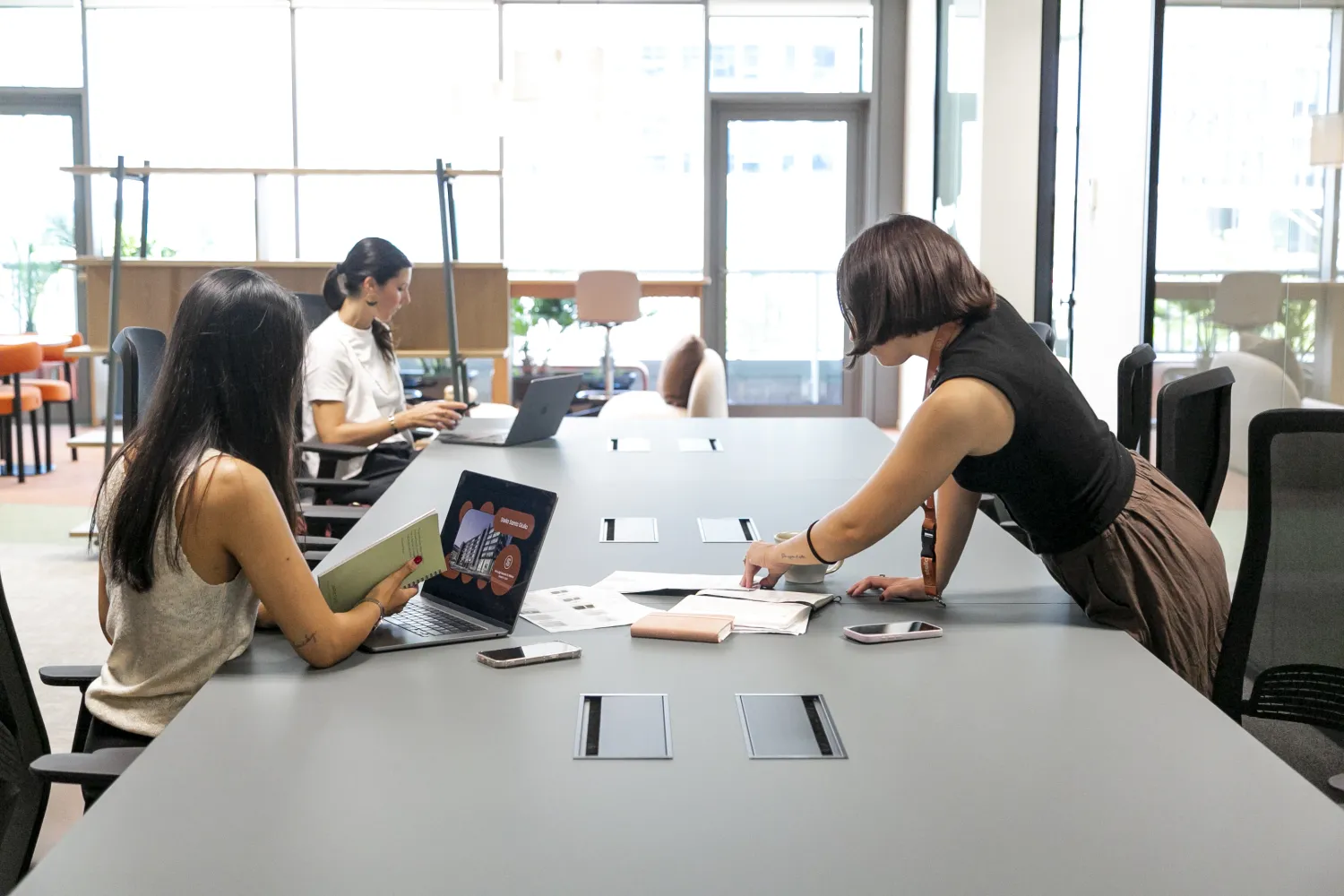
Today’s office market is divided into two distinct segments.
On one side, high-quality, ESG-compliant, experience-driven assets. On the other, obsolete buildings struggling with vacancy and declining value.
“The market no longer rewards the mere presence of square meters, but the integrated quality of experience.”
This polarization is visible in multiple indicators:
- in the U.S., more than 80% of net absorption is concentrated in Class A buildings
- buildings constructed before 2010 show vacancy rates exceeding 20%
- newer, high-performance buildings maintain vacancy below 10%
- rental resilience for ESG-aligned assets is 6–11 percentage points higher than non-compliant stock
In Italy, the trend is equally clear: approximately 70% of office take-up in Milan and Rome is concentrated in Grade A spaces.
At the same time, repricing has been significant. Office values in the U.S. have declined between 25% and 35% compared to pre-pandemic peaks, with some secondary markets experiencing even deeper corrections.
This has created a structural bifurcation:
- assets that attract capital, tenants, and talent
- assets that risk becoming stranded
Quality is no longer a differentiator, it is a survival condition.
ESG, technology and capex: the new drivers of value
In the new real estate cycle, value is no longer driven by passive income or yield compression.
It is driven by transformation.
“Capex has shifted from a tactical lever to a strategic prerequisite.”
The scale of investment required is significant:
- €500–1,500 per sqm for energy retrofits
- €1,800–3,000 per sqm for high-end fit-outs
- up to 40–60% energy reduction potential in deep renovation projects
At the same time, ESG is no longer optional. European regulation, including the EU Taxonomy and CSRD, has made environmental performance a financial variable, directly impacting access to capital and asset liquidity.
Buildings with high environmental performance:
- achieve rental premiums
- show lower vacancy
- benefit from better financing conditions
Technology plays an equally critical role.
Modern office buildings are increasingly equipped with:
- occupancy sensors
- air quality monitoring systems
- digital booking platforms
- real-time energy management
According to market surveys, over 60% of European occupiers already use digital tools to manage workspace utilization.
The building is no longer static, it becomes a dynamic data-driven platform.
Hybrid work, AI and future scenarios
Looking ahead to 2030, three structural forces will shape the future of office real estate:
- Hybrid work stabilization
- Cultural shifts in leadership
- Artificial intelligence
AI introduces a new dimension. Unlike the pandemic, which changed where work happens, AI may change how much work is required.
Estimates suggest that up to 25–30% of work activities in advanced economies could be automated or augmented by AI.
This has direct implications for office demand:
- potential reduction in administrative roles
- increased productivity per employee
- shift toward higher-value, collaborative work
At the same time, the relative importance of physical interaction may increase.
If routine work decreases, the remaining work becomes more relational, strategic, and creative, reinforcing the role of the office as a collaboration hub.
“The workplace becomes less a site of individual production and more a relational infrastructure.”
Strategic implications for companies and investors
The conclusion is clear: office real estate is no longer a passive asset.
It can no longer be treated as a fixed cost to be optimized periodically, but as a dynamic component of the organization—one that directly impacts performance, talent attraction, and long-term competitiveness.
It requires:
- active asset management
Office space must be continuously monitored, measured, and adjusted. This means going beyond traditional lease management and introducing real-time visibility on how space is actually used. Occupancy data, behavioral patterns, and utilization rates become critical inputs for decision-making. Leading organizations are already managing their workspace as a portfolio of assets with different roles—headquarters, collaboration hubs, proximity offices—each with specific KPIs. The objective is not to reduce space indiscriminately, but to maximize its effectiveness in supporting business outcomes.
- strategic alignment
The workplace must be designed as a direct extension of the business strategy. A company focused on innovation will require spaces that enable interaction, experimentation, and cross-functional exchange. A more execution-driven organization may prioritize efficiency and concentration. There is no universal model: the right workspace is the one that reflects how the organization creates value. This requires a much closer integration between real estate, HR, and leadership, ensuring that decisions on space are not taken in isolation but as part of a broader organizational design.
- continuous adaptation
The pace of change, driven by technology, workforce expectations, and market dynamics, makes static solutions obsolete. Office strategies must be inherently flexible, both contractually and physically. This includes modular layouts, scalable footprints, and the ability to reconfigure spaces over time. More importantly, it requires a governance model capable of revisiting assumptions regularly, testing new configurations, and evolving based on evidence rather than fixed policies.
“What matters is not how beautiful the office is, but how functional it is to the business.”
This is why new metrics are emerging, such as the Workspace Alignment Index™, which evaluates:
- economic efficiency
- spatial effectiveness
- impact on people
- adaptability to change
The focus shifts from cost minimization to value optimization.
Why download this white paper
This is not just a market overview.
It is a strategic tool grounded in empirical data, designed for decision-makers navigating complexity.
The office is not dead. It has become demanding.
And precisely because of this, it represents one of the most compelling and misunderstood asset classes of the next cycle.
Download the White Paper
Access the full report, including:
- 40+ pages of analysis
- global benchmarks and market data
- ESG and investment insights
- strategic scenarios for 2026–2030