- 1From container to relational infrastructure
- 2The rise of a polycentric workplace
- 3Designing the office from the inside out
- 4The office as a living experience
- 5A polarized market: quality as a dividing line
- 6Regeneration as the primary opportunity
- 7The office as an ecosystem of knowledge and relationships
- 8The evolving role of the architect
- 9Between digital and ecological transitions
- 10Conclusion: workspace as a strategic device
From container to relational infrastructure
In recent years, particularly since 2020, the demand for office space has undergone a profound transformation. The shift is not primarily quantitative, but qualitative.
As highlighted by Katia Gentilucci, architect and director at Progetto CMR, one of Italy’s leading integrated design and engineering firms, the office is no longer a neutral container of activities. It has become a relational platform, an identity-driven environment and a strategic lever for attracting talent, enabling engagement and shaping organizational culture.
In this context, companies are increasingly looking for spaces that reflect their values, embedded in accessible, connected and sustainable urban environments. The workplace is no longer evaluated only in terms of location or size, but in its ability to generate meaning, relationships and performance.
The rise of a polycentric workplace
While central and semi-central locations continue to attract demand, a parallel dynamic is emerging. Companies are increasingly exploring proximity-based solutions: distributed hubs, mixed-use districts and integrated urban environments.
This reflects a broader shift toward a more polycentric model of work. Working hubs and mixed-use developments are becoming key components of this evolution, enabling a more balanced distribution of urban functions and avoiding the rigidity of mono-functional districts.
At the same time, many organizations, particularly multinational corporations and consulting firms, are adopting more flexible operating models. Activities are partially decentralized, while headquarters evolve into highly representative and relational spaces.
Designing the office from the inside out
From a typological perspective, a new generation of offices is emerging. These environments are flexible, modular and designed starting from people’s needs rather than spatial conventions.
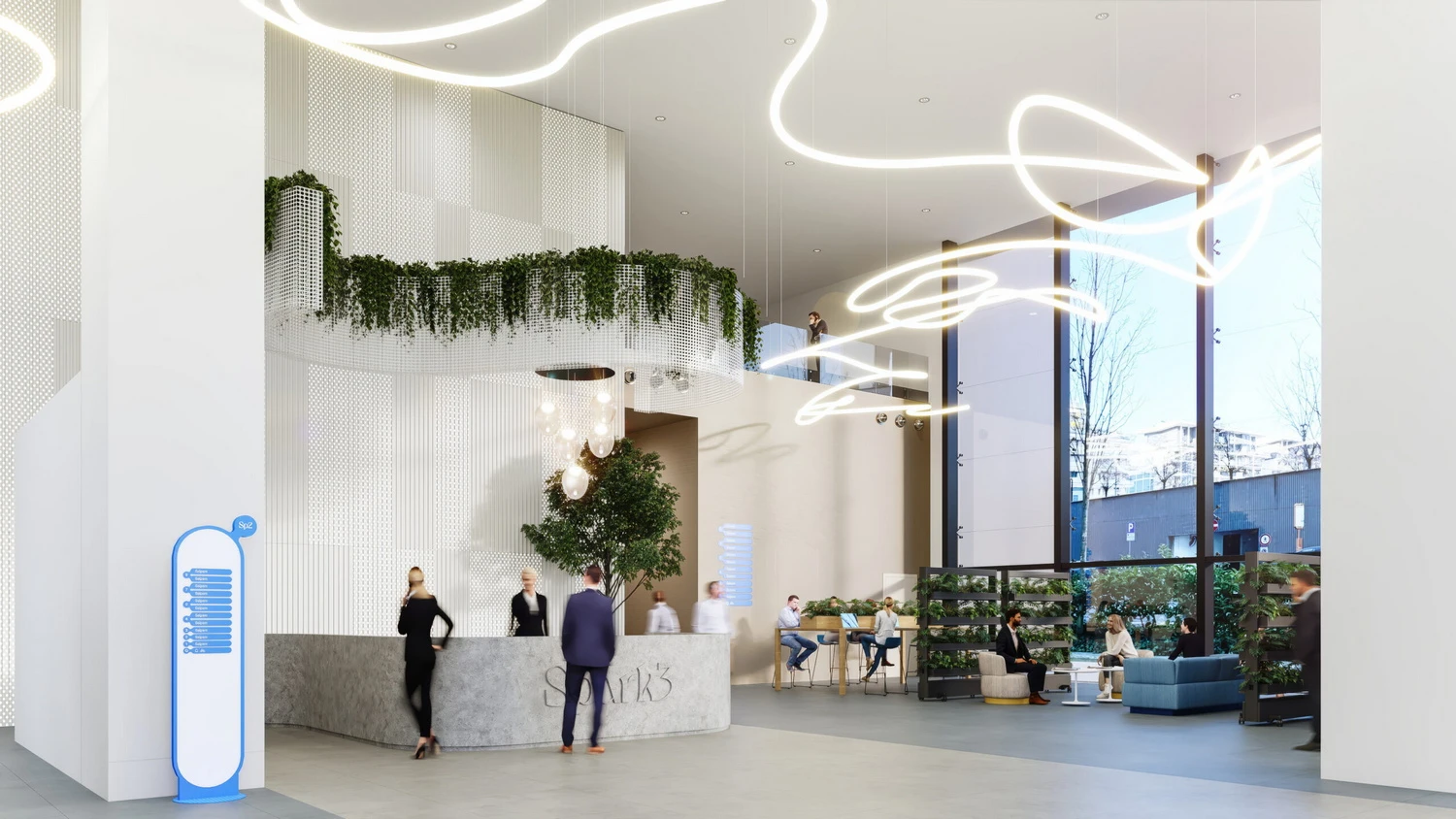
The workplace is expected to evolve over time, supporting hybrid work patterns while enabling both collaboration and concentration. Collaborative areas, informal spaces, greenery and digital infrastructure are integrated into complex ecosystems that enhance the daily experience of users.
This “inside-out” approach reflects a fundamental shift: space is no longer imposed on behavior. It is designed to support it.
The office as a living experience
End-user expectations have become increasingly clear, and non-negotiable. Sustainability, wellbeing, flexibility and sociality are now core requirements.
Air quality, natural light, acoustic comfort and access to spaces for movement and regeneration are no longer secondary features. They are central to how the workplace is perceived and used. The focus extends beyond functionality to include psychological and emotional dimensions.
In this perspective, the office becomes a “living place”, an environment where work and quality of life intersect, contributing to a more sustainable balance between professional and personal spheres.
A polarized market: quality as a dividing line
Across Italy, the gap between demand and supply is becoming increasingly evident, taking different forms depending on geography.
Milan represents the most advanced market, but also the most polarized. On one side, a large stock of obsolete buildings. On the other, a highly selective demand concentrated on new-generation, sustainable and technologically advanced assets. The core gap is not volumetric, but qualitative and energy-related.
Rome presents a different dynamic. Demand exists but is constrained by a limited pipeline of contemporary developments. The historical building stock offers significant value, yet requires complex interventions to meet current standards.
In the rest of the country, the gap is even wider, reflecting both infrastructural and cultural limitations. Many buildings remain energy-inefficient, inflexible and misaligned with contemporary work models.
Regeneration as the primary opportunity
In this context, urban regeneration emerges as the most relevant opportunity.
Repositioning existing assets, upgrading buildings and reintroducing quality into the built environment is not only a response to market demand. It is a driver of broader social and territorial transformation.
Projects such as large-scale developments in Milan demonstrate how new business districts can integrate workspace, services, public areas and green spaces into cohesive urban systems. At the same time, interventions on historical assets, such as the redevelopment of office buildings in Rome, show how heritage and innovation can coexist through careful design and space planning.
The common denominator is a shift in perspective: from isolated buildings to integrated ecosystems.
The office as an ecosystem of knowledge and relationships
What connects these experiences is a shared vision of the office as more than a physical space. It becomes an ecosystem of knowledge, relationships and innovation, capable of reflecting corporate identity and contributing to urban development.
In this paradigm, value is generated not only by architecture or location, but by the ability of space to enable interaction, learning and cultural cohesion.
The evolving role of the architect
Within this transformation, the role of the architect is also changing.
From being an author of forms, the architect becomes a coordinator of complex processes. The profession increasingly requires the integration of multiple competencies, economic, environmental, social and cultural, while mediating between different stakeholders and objectives.
Design is no longer limited to buildings. It extends to relationships, behaviors and systems.
Between digital and ecological transitions
The ecological and digital transitions further reinforce this evolution.
Advanced digital tools, including artificial intelligence and data-driven models, enhance analytical capabilities and enable more informed design decisions. However, they do not replace vision. The real value lies in the ability to transform data into meaning, and meaning into space.
The architect becomes a mediator between past and future, between constraints and opportunities, between technology and human experience.
Conclusion: workspace as a strategic device
The transformation underway is not limited to office space. It reflects a broader redefinition of the relationship between people, places and organizations.
The office is no longer a passive container. It becomes a strategic device, capable of generating value, culture and wellbeing.
In this sense, architecture regains a central role. Not only as a discipline of form, but as a tool to interpret and guide one of the most significant transformations of contemporary work.