- 1A conversation with Alessandro Cia, CEO of Quadrifoglio Group, on how the industry is responding to a new generation of workplace demand
- 2Pietro Martani: How has the market changed over the past decade, and what did the pandemic accelerate?
- 3Pietro Martani: Collaboration and interaction seem to be at the centre of this evolution. Do you see organizations approaching this with clarity, or is there still uncertainty about how to make collaborative environments work?
- 4Pietro Martani: One theme that keeps emerging is flexibility, not just in how people work, but in how furniture itself needs to adapt. Is this something you are seeing in practice?
- 5Pietro Martani: Are you seeing a shift in how companies organize their real estate, from centralized headquarters toward more distributed models?
- 6Pietro Martani: Can you share a case that exemplifies this new approach to workplace design?
- 7Pietro Martani: What role does the designer play in all of this?
- 8About Quadrifoglio Group
A conversation with Alessandro Cia, CEO of Quadrifoglio Group, on how the industry is responding to a new generation of workplace demand
The office furniture industry is one of the most tangible indicators of how workplaces are actually evolving, not in theory, but in procurement decisions, production lines and project briefs.
For decades, the industry revolved around a single unit of output: the workstation. A desk, a pedestal, a task chair, replicated across floors and buildings with minor variations. The business model was built on volume, standardization and replacement cycles.
That model is dissolving. According to CBRE’s 2026 Global Workplace & Occupancy Insights, individual space has dropped from 56% of total office area in 2021 to 35% in 2025, while amenity space has more than doubled from 10% to 22%. The Gensler Global Workplace Survey 2025 confirms that noise, acoustic privacy and the quality of informal meeting areas are now among the top concerns for employees. The result is a structural shift in what organizations buy: fewer desks, more acoustic panels, phone booths, modular meeting pods, height-adjustable tables, living-room-grade soft seating, and advanced lighting systems. Manufacturers who fail to diversify their offer risk becoming irrelevant to a market that no longer orders offices, it designs environments.
Alessandro Cia leads Quadrifoglio Group, one of Italy’s foremost office furniture manufacturers. In this conversation, he describes how the transformation of work is reshaping the industry from within.
Pietro Martani: How has the market changed over the past decade, and what did the pandemic accelerate?
Alessandro Cia: The shift was already underway before 2020, but the pandemic made it irreversible. For years, our industry was organized around the workstation, the goal was to deliver complete, efficient, well-designed individual setups. That was the core of the business.
After 2020, the conversation moved from workstations to work environments. The office is no longer defined by a single function. Work today is hybrid, and I don’t just mean in terms of location. People move through different activities within the same day: focused individual work, informal conversations, team alignment, video calls, creative sessions. A recent study from the University of Camerino describes this fluidity well. People are constantly connected, moving through the space with a notebook or a tablet, shifting between contexts.
This has forced us to completely rethink our product range. We were manufacturers of desks and storage units. Today we produce full environment systems: operative and executive workstations, reception areas, meeting rooms, a complete range of seating, from task chairs to lounge and living-style pieces, as well as architectural partition walls, lighting systems, and acoustic elements. These are no longer niche additions. They are essential product families for creating a complete workplace.
We have also introduced a living catalogue, products designed for residential and hospitality contexts, but increasingly used in offices. The intersection between office and living environments is growing rapidly, and manufacturers need to operate across both worlds.
Pietro Martani: Collaboration and interaction seem to be at the centre of this evolution. Do you see organizations approaching this with clarity, or is there still uncertainty about how to make collaborative environments work?
Alessandro Cia: Collaboration is absolutely fundamental, and there is growing investment in spaces that support it. That said, the individual workstation still matters, productivity and efficiency depend heavily on the quality of the operative setup. The two dimensions coexist.
What I observe is that beyond collaboration, organizations are asking for something deeper: comfort, ergonomics, safety, proper lighting, both in terms of intensity and directionality, and above all, acoustic quality. Anyone who has spent hours in a poorly treated open space knows the impact. Noise accumulates. It erodes concentration and wellbeing over the course of a day.
Space division has also become critical, even in open environments. Creating physical moments of privacy, areas where people can isolate, focus, or hold a confidential conversation, is now a design priority. These are not enclosed offices in the traditional sense. They are modular, sometimes temporary, elements that give people choice.
As for repeatable formats or standard solutions: frankly, no. Every project is increasingly tailor-made. It is an artisanal approach, bespoke solutions built around the client’s specific needs. The commercial function has changed accordingly. It used to be about selling products. Today, most of the work happens upstream: understanding the client’s problems, mapping how people move through the space, analysing workflows. The project comes after that.
Pietro Martani: One theme that keeps emerging is flexibility, not just in how people work, but in how furniture itself needs to adapt. Is this something you are seeing in practice?
Alessandro Cia: There are two dimensions of flexibility, and they operate at different speeds.
The first is people flexibility, and this is fully consolidated. Organizations routinely design for fewer workstations than headcount. If 150 people are assigned to a location, the client might commission 120 positions, because on any given day a proportion of the workforce is travelling, working remotely or in meetings elsewhere. This kind of planning is now standard.
The second is physical flexibility, furniture that can be reconfigured, moved, folded, repositioned. We produce folding tables on wheels, for instance, that can be rearranged in minutes to shift a space from a training room to a collaborative workshop to an individual work area. This is a more recent development. The market is still in an early phase, but demand is growing. Organizations that face unpredictable project cycles or rapidly changing team structures need environments that can be reshaped without calling in a fit-out contractor.
Pietro Martani: Are you seeing a shift in how companies organize their real estate, from centralized headquarters toward more distributed models?
Alessandro Cia: This started before Covid and reached its peak during the pandemic, when remote work became the default and we all became proficient with video conferencing. That experience made organizations more efficient, more sustainable and in many ways more humane, people could integrate work with personal needs in a way that was previously difficult.
However, I sense a counter-movement. There is a visible return to physical offices. Large multinational groups, Amazon and Google among them, are making significant investments in new, large-scale workplaces. It may seem paradoxical given the remote work revolution, but these companies are doubling down on physical presence.
I think within a few years we will have a clearer picture of where the equilibrium settles. But what is already evident is that the office is not disappearing. It is being redesigned with much higher expectations, and the investment levels reflect that.
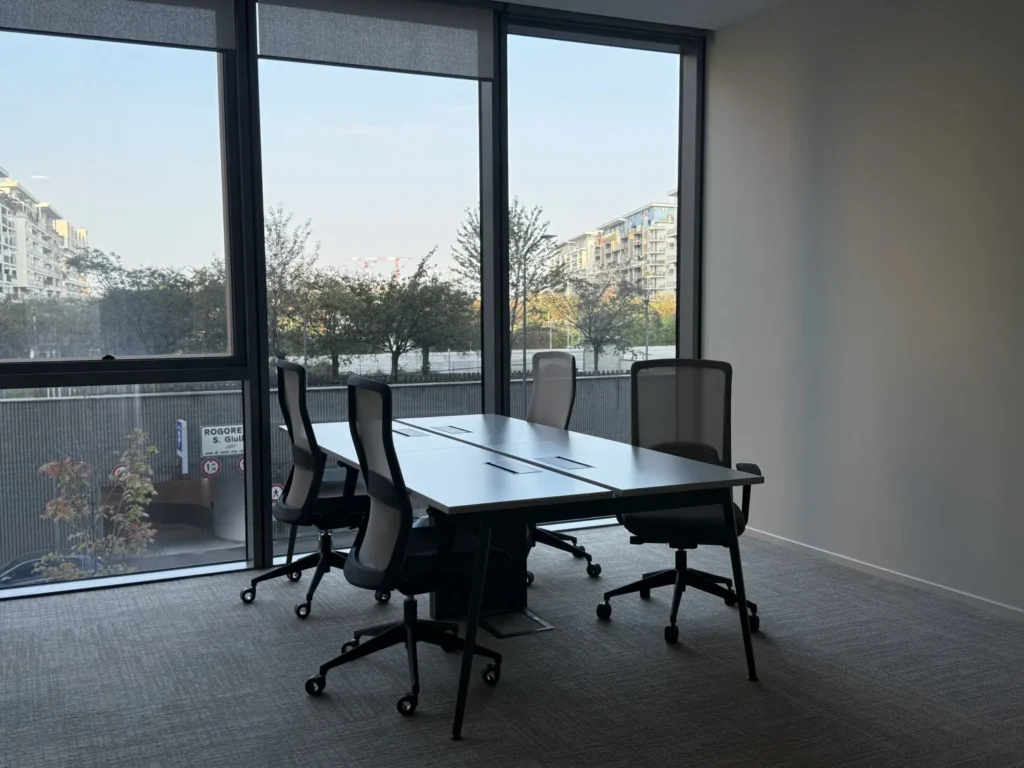
Pietro Martani: Can you share a case that exemplifies this new approach to workplace design?
Alessandro Cia: One project that stands out is the headquarters we furnished for Marine Interiors, part of the Fincantieri Group, in the province of Udine. It was a comprehensive project involving high-level professionals and external consultants.
What made it distinctive was the depth of the process. We worked from the ground up on every dimension: flexibility, ergonomics, quality of work, wellbeing, and aesthetics. We spend the majority of our lives in work environments. I believe there is a responsibility to make them beautiful, not just functional. Iconic and emotional elements matter.
The project included full operative and executive areas, open spaces calibrated to the right team size, not too large, to avoid the noise and distraction of oversized floors, dedicated zones for informal collaboration and short alignments, custom-designed lockers for personal storage, and a major boardroom for institutional meetings.
A significant portion of the furniture was designed on a bespoke basis. Marine Interiors works in naval interior design, so they brought their own design culture and identity expectations to the table. The result was a space that communicates who they are, not just to employees, but to clients and partners who visit.
Pietro Martani: What role does the designer play in all of this?
Alessandro Cia: The role of what I would broadly call the “workspace designer” has become absolutely central. This function takes different forms depending on the project: sometimes it is the manufacturer’s in-house design team, sometimes external architects, sometimes large architecture firms, sometimes general contractors with integrated design capabilities, and sometimes distributors who have built their own consultancy function, often as a condition for remaining competitive.
In every case, the common thread is that the design function is no longer optional. It is the connective tissue between the client’s organizational needs and the physical environment. Without it, you are simply placing furniture in a room. With it, you are creating a system that supports how people actually work.
About Quadrifoglio Group
Quadrifoglio Group is one of Italy’s leading manufacturers of office furniture and workplace systems, headquartered in the Veneto region. The company operates across a comprehensive product range, from operative and executive workstations to seating, acoustic solutions, partition walls, lighting and living-style furnishings, serving the Italian market and a growing international network of clients. With a production capacity that combines industrial scale with a strong orientation toward customization, Quadrifoglio has positioned itself as a partner for organizations navigating the transition from traditional office setups to integrated, activity-based work environments.