Fabio Clabot’s professional journey spans very different contexts: large multinational corporations, mid-sized companies, and eventually his entrepreneurial experience with Small Pixels.
This trajectory has allowed him to closely observe how workspaces concretely influence organization, productivity, and the overall quality of work.
In the large companies where he worked, including Sky, Mediaset, and British Telecom, the prevailing model was the typical corporate setup: large open spaces, few meeting rooms, and in some cases private offices for executives.
The objective was clear: to foster communication among employees while optimizing costs. However, in everyday practice, this model revealed evident limitations.
Open space, in fact, is not a neutral environment. Some people can adapt and work effectively even in noisy settings, while for others it becomes difficult to maintain focus and continuity. This often leads to a recurring dynamic: in order to work effectively, people are forced to constantly move into meeting rooms or improvised spaces, which are often not suitable.
Moreover, many activities require a level of confidentiality that open space cannot guarantee. From this perspective, private offices are not a benefit, but an operational necessity for certain functions.
In recent years, this model has continued to evolve. In some large organizations, even executives are progressively being moved into open space environments, in an effort to reduce hierarchy and increase accessibility. However, according to Clabot, this approach risks overlooking a fundamental aspect: certain managerial activities inevitably require moments of concentration and privacy, which cannot be entirely eliminated.
Remote Work: Efficiency Without Relationships
With the founding of Small Pixels, the working model changed radically.
At the beginning, the company consisted of a small team of four people in Florence, while Clabot worked from Milan. For about a year, all activities were managed remotely through digital tools such as Teams and video calls.
This model proved effective from an operational standpoint, but quickly revealed a significant limitation: the absence of a social and relational dimension.
Remote collaboration works for coordination, but it cannot replace the quality of in-person interaction. The ability to build relationships, engage in spontaneous exchanges, and create a sense of belonging is diminished.
This phase represents a key transition: work can be distributed, but an organization cannot be built solely through digital tools.
Choosing a Physical Space: Not an Office, but a System
As the company grew, the need to identify a physical space emerged.
Not as a return to a traditional model, but as a deliberate choice: to create an environment aligned with how people actually work.
Work at Small Pixels is structured around very different types of activities:
- individual, high-focus work
- small group collaboration
- one-to-one meetings
- shared working moments
- interactions with clients and stakeholders
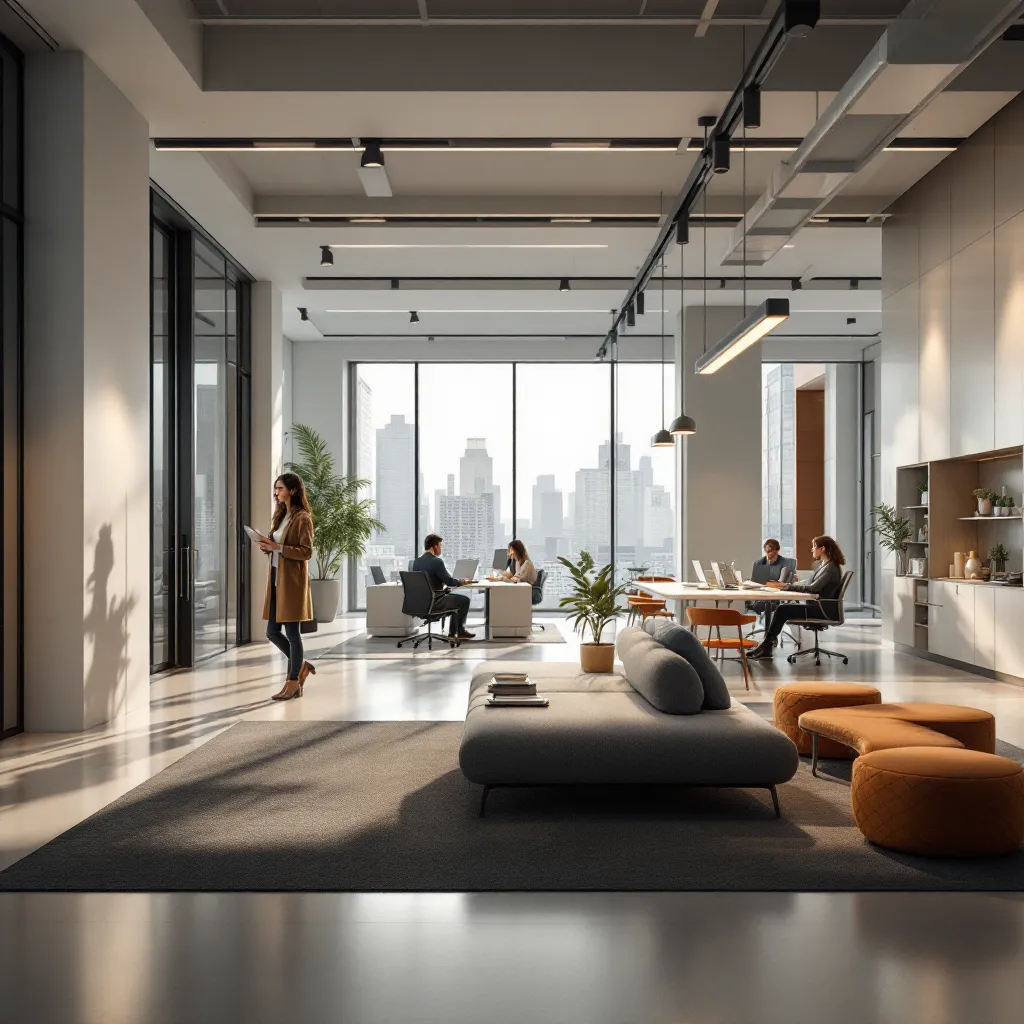
This diversity makes it clear that no single space can effectively support all activities. What is needed is a system of different environments, each designed for a specific type of work.
This led to the decision to establish the company’s headquarters at Stella Santa Giulia, a space capable of responding to these needs in a flexible way.
On one hand, it is essential to have environments suited to daily work; on the other, the space must also be representative, particularly in moments of interaction with clients and stakeholders.
How People Actually Use Space
Once operating within a flexible environment, an interesting behavior emerges: people begin to use spaces differently depending on the activity.
For example:
- focused work takes place in quieter environments
- brainstorming shifts to informal areas such as sofas or shared spaces
- calls are conducted in acoustically isolated booths
- creative work happens in more relaxed settings
Even breaks take on a different role. Moments such as coffee or informal conversations are not simply interruptions, but become productive exchanges where ideas and solutions emerge.
A recurring element is movement: walking, changing environments, and leaving the workstation help stimulate thinking. These dynamics are also supported by neuroscientific evidence, such as the importance of natural light and environmental stimuli for cognitive performance.
The Limits of Working from Home
When comparing in-office and remote work, Clabot expresses a clear personal preference.
Working from home tends to blur the boundary between personal and professional life, making it more difficult to separate the two. The presence of family and the domestic environment can reduce focus and weaken boundaries.
By contrast, physically going to a workplace helps activate a different “mental state,” supporting focus and intentionality.
While acknowledging that preferences vary across individuals, this highlights an important point: physical space has not only an operational function, but also a psychological one.
Workspace and Talent: A Lever for Attraction and Retention
At Small Pixels, workspace is closely linked to the quality of talent.
The company works with highly specialized profiles, often difficult to find on the market: professionals in the video industry and research-oriented roles with advanced academic backgrounds.
In this context, workspace becomes a relevant factor in the decision to join the company.
Poorly lit, low-quality environments do not encourage presence, in fact, they often create a desire to leave as soon as possible. Conversely, well-designed spaces, with natural light, welcoming areas, and effective working conditions, contribute to making work more sustainable.
A concrete example comes from a member of the marketing team, who decided to join the company partly based on the workspace experience during the interview process.
This does not mean that workspace is the only factor in retention, but it represents an important element within a broader system. In particular, it contributes to building a sense of community, fostering relationships, exchanges, and potential collaborations with other organizations within the same environment.
Conclusion
Fabio Clabot’s experience highlights a key insight:
workspace is no longer a passive container, but an active component of the organization.
The question is no longer whether to choose between open space, private offices, or remote work. Instead, it is about designing a coherent system that supports different modes of work, enabling focus, collaboration, relationships, and representation.