- 1The polarization of demand: centrality, quality and new urban geographies
- 2From cost center to strategic asset: the evolution of office space
- 3The new workplace experience: services, wellbeing and technology
- 4A structural imbalance: demand exceeds supply
- 5Italy vs global markets: a distinct trajectory
- 6Case studies: from space to experience
- 7Investment strategies: repositioning, partnerships and new geographies
- 8Conclusion: the Italian office between hybrid equilibrium and strategic repositioning
In a market increasingly defined by selectivity and transformation, the Italian office real estate sector stands out for its resilience and structural evolution. While global narratives often oscillate between the “death of the office” and a full return to pre-pandemic models, Italy presents a more nuanced trajectory, one that reflects both continuity and adaptation.
In this conversation, Pietro Martani, curator of Limitless Workspace, engages Fabio Mantegazza, Head of Leasing Italy at CBRE, the world’s leading real estate advisory firm. The discussion provides a grounded, market-driven perspective on how occupier demand is reshaping the office landscape across Italy, particularly in Milan and Rome.
What emerges is not a contraction of the office market, but a reconfiguration of its value drivers. Demand has not disappeared; it has become more selective, more demanding, and more aligned with organizational strategy. Location, quality, flexibility, and user experience are no longer differentiators, they are prerequisites.
Italy appears to be consolidating a hybrid model that is less extreme than in Anglo-Saxon markets, combining a strong cultural attachment to the physical office with a pragmatic integration of remote work. At the same time, a structural imbalance between supply and demand, especially for Grade A assets, is reshaping pricing dynamics and investment strategies.
In line with broader market evidence, where the office has shifted from passive asset to active platform for organizational value , the Italian case confirms a key transition: the workplace is becoming an intentional infrastructure, designed to support talent, culture, and performance rather than simply hosting them.
The polarization of demand: centrality, quality and new urban geographies
Pietro Martani: How has office demand changed since 2020 in terms of location and tenant profile?
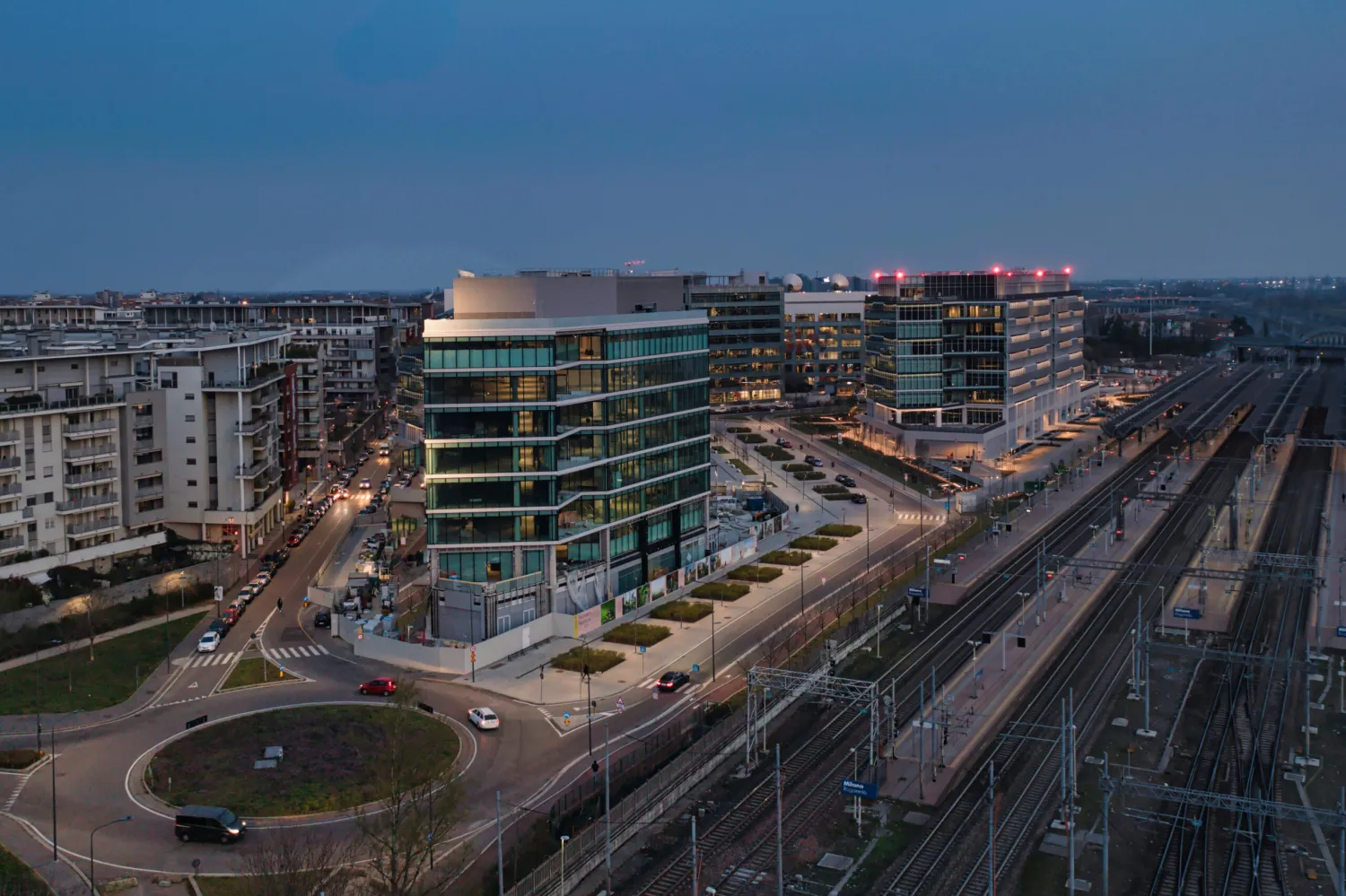
Fabio Mantegazza: Since 2020, demand has clearly polarized towards top quality. Large corporates, particularly Big Tech, banks, insurance companies, and law firms are targeting assets in Milan’s Central Business District and iconic areas such as Porta Nuova and CityLife. Competition for prime buildings in these locations is extremely intense, with prime rents in Milan reaching a record €770 per square meter per year.
However, the saturation of central areas is now driving strong interest toward semi-central locations. These areas offer an optimal balance: access to services such as retail and dining, combined with strong public transport connectivity. They respond to companies’ need to be present in dynamic yet less congested environments.
From cost center to strategic asset: the evolution of office space
Pietro Martani: What type of office space are companies looking for today?
Fabio Mantegazza: Office space is evolving from a cost center into a strategic lever for talent attraction. There is no longer a single model. We see a spectrum, from traditional offices meeting new quality standards to more advanced environments functioning as social and collaborative hubs.
For companies with younger workforces, particularly Gen Z, the office must promote wellbeing and collaboration. Social interaction is no longer a break from work, it is part of productivity. The market demands Grade A buildings capable of combining residential comfort with professional efficiency. The office of the future is an “adaptive space” that reflects corporate culture and fosters a sense of belonging.
The new workplace experience: services, wellbeing and technology
Pietro Martani: What services are most valued by end users?
Fabio Mantegazza: Users are looking for what they cannot replicate at home: an ecosystem that enables social interaction and innovation. According to our Beyond Space Italy Office Workers Survey 2025, 89% of employees consider technological equipment, such as adjustable desks and dual monitors, essential. At the same time, they expect shared areas, equipped kitchens, and dedicated lunch spaces.
Thermal comfort, sustainability, and access to green areas or terraces are key decision drivers. People want a mix of quiet zones for focused work and welcoming spaces for informal meetings and brainstorming. The office is becoming a place that supports both physical and mental wellbeing.
A structural imbalance: demand exceeds supply
Pietro Martani: What is the current gap between demand and supply across Italy?
Fabio Mantegazza: The market is currently heavily unbalanced, there is significantly more demand than supply. In Milan, overall vacancy is around 10%, but for Grade A assets it drops to 3.3%, and even to 0.9% in the CBD. Rome shows an even tighter situation, with a historic low vacancy of 6.4% and only 0.55% availability for Grade A in the city center.
This shortage of ready-to-use product is limiting absorption volumes, despite very strong demand. The trend has reversed compared to the past: scarcity of prime assets is now driving continuous rental growth.
Italy vs global markets: a distinct trajectory
Pietro Martani: Do Italian trends align with global dynamics?
Fabio Mantegazza: Italy shows a unique resilience compared to the United States and other European markets such as the UK and France, where remote work is more widespread. In Italy, there is still a strong attachment to the physical office, and we are moving toward a model that resembles the pre-pandemic structure, but with approximately one day of remote work integrated.
While some global markets are struggling, the Italian office leasing sector closed 2025 with record performance. An exception can be seen in banking and insurance, where existing space surplus has led to footprint optimization. Overall, however, the Italian market remains highly dynamic and strongly oriented toward physical presence.
Case studies: from space to experience
Pietro Martani: Can you share some successful projects?
Fabio Mantegazza: We have managed transactions that clearly reflect market evolution. In Via Meravigli in Milan, we completed three deals transforming a historic asset into an educational hub, demonstrating how city center buildings can be repositioned.
Another iconic example is CityLife, where we focused on a cutting-edge development in terms of energy efficiency and ESG criteria. These cases show that demand rewards buildings capable of offering an experience, not just square meters.
Investment strategies: repositioning, partnerships and new geographies
Pietro Martani: How are investment strategies evolving?
Fabio Mantegazza: Investment strategies today are driven by a deeper understanding of occupier needs, which have become far more complex. The scarcity of value-add opportunities in central areas is pushing investors to focus on technology and deep refurbishment to meet new quality standards.
Long-term partnerships and meaningful projects integrating sustainability and flexibility are increasingly preferred. Looking ahead to 2026, we expect continued growth in build-to-suit developments and rising interest in new locations, as companies seek alternatives to increasingly expensive central areas.
Conclusion: the Italian office between hybrid equilibrium and strategic repositioning
What clearly emerges from this conversation is that the Italian office market is not retreating, it is consolidating around a more structured and intentional model. The hybrid paradigm is no longer experimental. It is stabilizing into what can be described as a “4+1” configuration: four days in the office, one day remote, with important variations depending on company size and sector.
Smaller organizations tend to rely more heavily on physical presence, often due to cultural cohesion, operational simplicity, and the need for direct coordination. Larger corporations, by contrast, are more likely to integrate remote work structurally, leveraging digital infrastructure and distributed teams while maintaining strong headquarters as relational hubs.
At the same time, companies are actively reducing contractual rigidity. The traditional long-term, inflexible lease is being reconsidered in favor of more adaptable solutions, whether through flexible layouts, phased commitments, or hybrid models combining headquarters and satellite locations. This shift reflects not only uncertainty, but a more mature approach to corporate real estate as a managed resource rather than a fixed cost.
Perhaps most importantly, the office is being redefined as a strategic platform. It must represent corporate identity, attract and retain talent, and enhance organizational performance. Location, design, services, and experience are no longer independent variables, they converge into a single value proposition.
In a context of structural polarization, where high-quality assets outperform and secondary stock struggles to remain competitive, the Italian market reinforces a broader conclusion: the office is no longer evaluated by how much space it provides, but by what it enables.
The office has not disappeared. It has become more demanding, and for those able to interpret this shift, significantly more strategic.