- 1From assigned desks to intentional environments
- 2Applying ABW in multi-tenant environments
- 3Designing for privacy, concentration and fluidity
- 4The Corte: a social and relational core
- 5Color as a language of activities
- 6Atmosphere: light, sound and experience
- 7Nature, materials and wellbeing
- 8From model to lived experience
Activity Based Working (ABW) is often described as a workplace strategy. In reality, it is more accurately understood as a shift in how work itself is structured and supported. At its core, ABW is based on a simple principle: different activities require different environments. Work is no longer tied to a fixed desk, but distributed across a variety of settings designed to support focus, collaboration, interaction and informal exchange.
The concept emerged in Northern Europe in the late 20th century, particularly in the Netherlands, where early experiments began to challenge the traditional one-desk-per-person model. Over time, it evolved into a broader framework adopted by global organizations seeking to improve productivity, optimize space and respond to increasingly dynamic ways of working.
Today, Activity Based Working represents one of the most mature interpretations of the relationship between people, space and performance. It acknowledges that work is not homogeneous, and therefore space should not be either.
From assigned desks to intentional environments
In a traditional office model, space is organized around roles and hierarchies. Individuals are assigned desks, often regardless of the type of work they perform throughout the day. This creates inefficiencies, both in terms of space utilization and in terms of individual productivity.
Activity Based Working reverses this logic. Instead of assigning space to people, it assigns space to activities. Individuals choose where to work based on what they need to do at a given moment: concentrate, collaborate, meet, reflect, connect.
This shift requires not only a redesign of physical space, but also a cultural evolution. Trust, autonomy and clarity of objectives become central. Without them, the model risks becoming a superficial redesign rather than a true transformation.
Applying ABW in multi-tenant environments
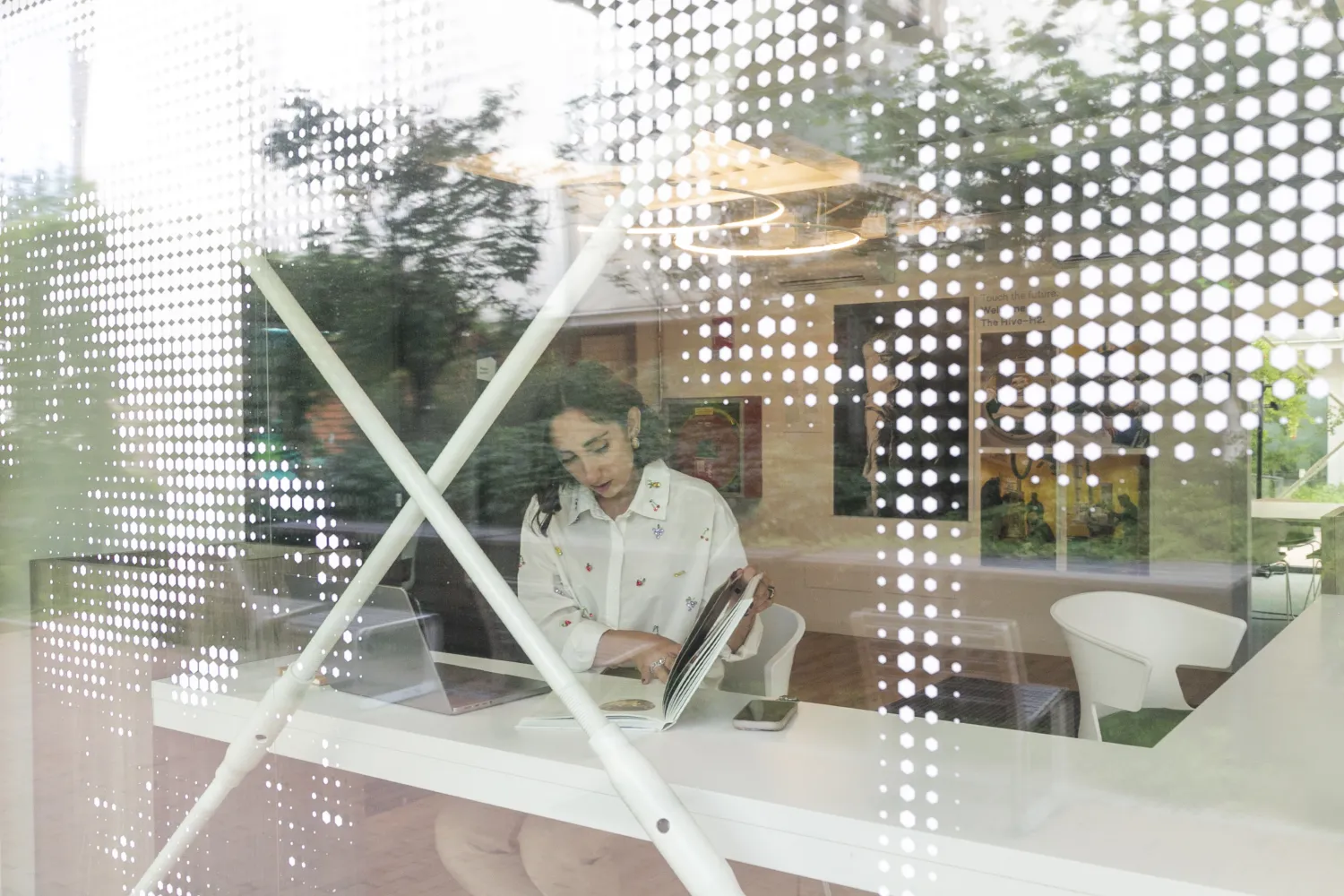
While ABW is often associated with large corporate headquarters, its application in multi-tenant environments introduces additional complexity. Different companies, different cultures and different working patterns must coexist within a shared infrastructure.
Stella Santa Giulia represents a particularly advanced example of how Activity Based Working can be translated into a multi-tenant context.
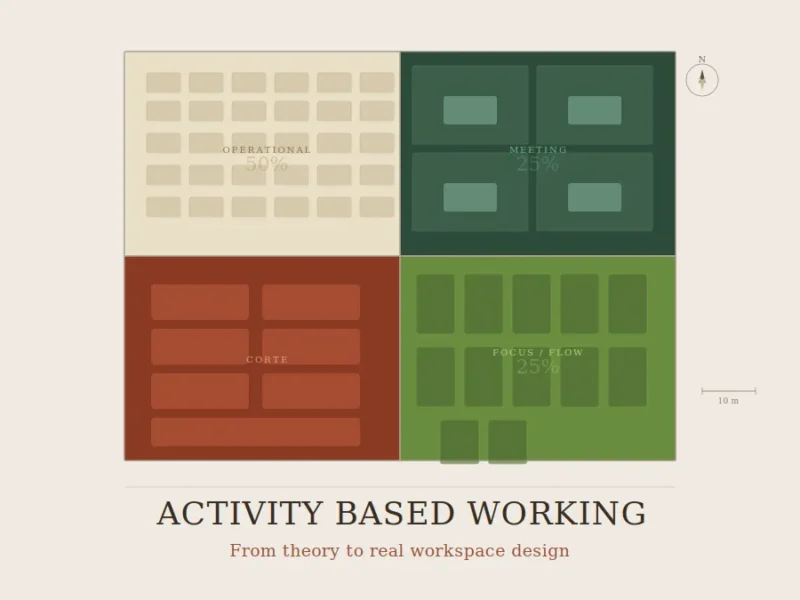
The space is structured with a clear distribution: approximately 50% is dedicated to operational offices, 25% to formal meeting rooms of different sizes, and the remaining 25% to distributive areas such as lounges and informal working environments. This balance reflects the understanding that work is not only execution, but also interaction, exchange and regeneration.
Within this ecosystem, flexibility is not an abstract concept. It is embedded in the physical layout and in the availability of diverse settings that support different modes of work throughout the day.
Designing for privacy, concentration and fluidity
One of the critical aspects of Activity Based Working is ensuring that individuals can find the right level of privacy and focus when needed.
In Stella Santa Giulia, this is addressed through the presence of eleven phone booths, offering dedicated spaces for calls and moments of concentration. Considering that the space includes around 200 workstations and hosts an average daily population of 100 to 120 people, this represents one of the highest ratios in Europe for this type of solution.
This detail is not secondary. It reflects a precise design intention: enabling fluid transitions between open collaboration and private focus without friction. In ABW environments, the absence of such micro-spaces often becomes a limiting factor. Here, it is treated as a core component of the experience.
The Corte: a social and relational core
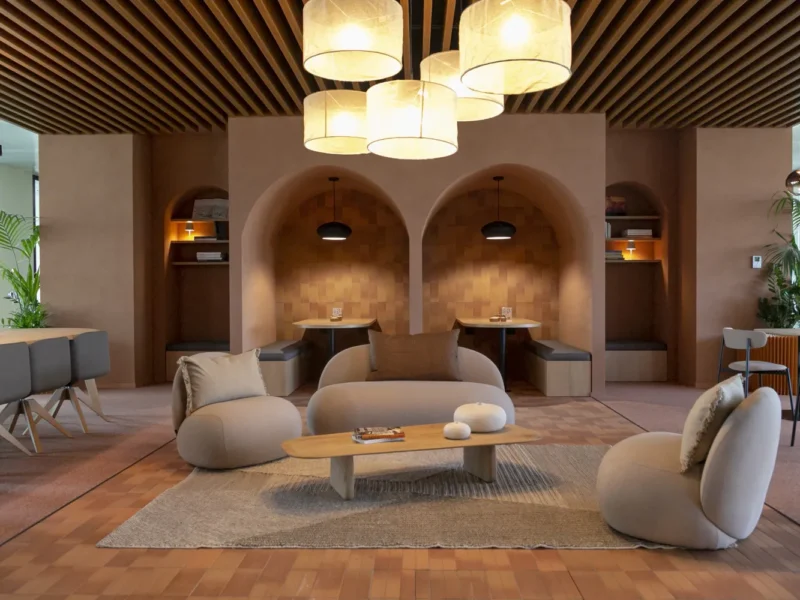
At the center of Stella Santa Giulia lies the Corte, the social heart of the space. More than a common area, it functions as a crossroads where different flows of people intersect.
The Corte offers high-quality coffee, kitchen services and communal tables designed to encourage interaction. It is a place where conversations happen naturally, where professional exchanges blend with informal moments, and where relationships are built over time.
In an Activity Based Working environment, spaces like the Corte are essential. They are not residual areas, but intentional nodes that support one of the most important dimensions of work: the relational one.
Color as a language of activities
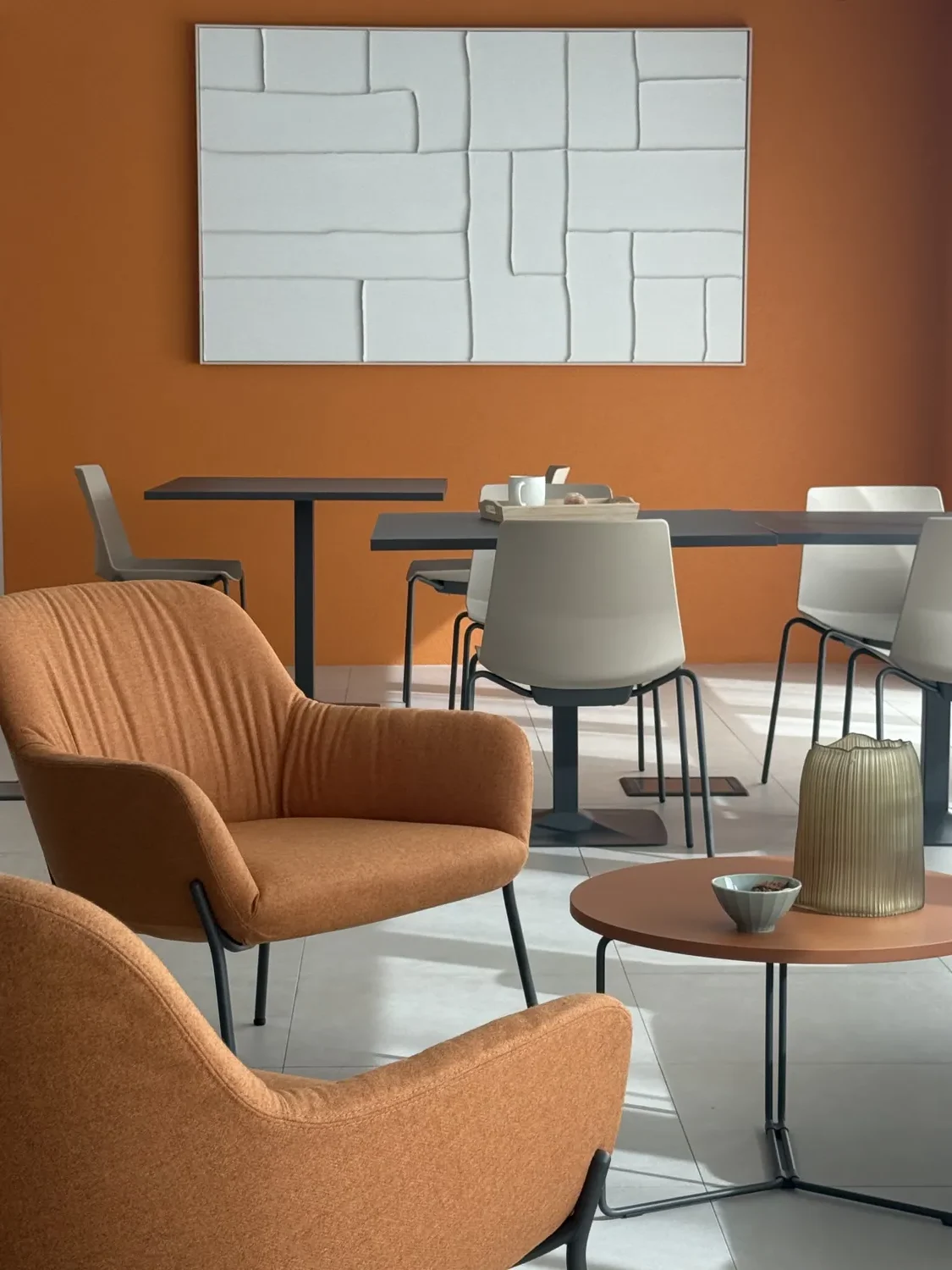
One of the most distinctive elements of Stella Santa Giulia is the use of color as a tool to communicate and reinforce activities.
Each area is characterized by a specific palette. Operational offices are defined by sand tones, creating a calm and neutral environment conducive to focus. Meeting rooms are marked by dark green, signaling concentration and depth. Corridors adopt a grass green, evoking the sensation of walking through an outdoor path. The Corte and lounge areas are defined by brick red, recalling the idea of a square, a place of gathering and exchange.
This chromatic system is not decorative. It acts as a subtle but effective guide, helping users intuitively understand the nature of each space and adapt their behavior accordingly.
Atmosphere: light, sound and experience
Beyond layout and color, Stella Santa Giulia integrates light and sound as active components of the workspace experience.
Lighting is designed to support different scenarios throughout the day, enhancing concentration in focused areas and creating a more relaxed atmosphere in social spaces. Music, diffused across common areas, contributes to shaping the environment, facilitating transitions between work modes and supporting events or informal interactions.
These elements work together to create a dynamic environment where space is not static, but responsive to activities and moments.
Nature, materials and wellbeing
Another key dimension of the space is its connection to natural elements.
Green areas, terraces and abundant natural light contribute to opening up the environment, both physically and psychologically. Artworks made with natural materials and organic colors reinforce this connection, creating a sense of continuity between indoor and outdoor experiences.
The intention is clear: to move away from the perception of the office as a rigid, artificial environment, and instead evoke the feeling of being in a more natural setting. This has a direct impact on wellbeing, mood and ultimately productivity.
In this sense, Activity Based Working extends beyond functionality. It touches emotional and sensory dimensions, recognizing that performance is influenced not only by tools and processes, but also by how people feel within a space.
From model to lived experience
The case of Stella Santa Giulia shows that Activity Based Working is not a theoretical framework, but a design practice that integrates space, behavior and experience.
It requires a balance between structure and flexibility, between individual needs and collective dynamics, between efficiency and quality of life.
When implemented coherently, ABW transforms the office from a static container into a living system. A system where people can choose how to work, where space adapts to activities, and where the environment actively supports both productivity and relationships.
In this perspective, the future of workspace is not about reducing space or increasing density. It is about designing environments that are capable of supporting the complexity of contemporary work.