- 1Innovamey and the consistency between what you say and what you do
- 2Diversity as a driver of better decisions
- 3What large organizations taught Aram Mbow about workspace
- 4Returning to the office must have a reason
- 5Beauty as a form of care
- 6Workspace as a relational infrastructure
- 7Hybrid work at Innovamey: first how, then where
- 8Workspace, cost and governance: a design choice
- 9For Aram Mbow, ESG is not a function. It is innovation
- 10Measurement as a starting point
- 11When sustainability becomes desirable, it creates value
- 12Real estate and sustainability by design
- 13Shared economy and workspace
- 14A final perspective
For Aram Mbow, founder of Innovamey, sustainability is not a side function of the company. It is the contemporary way of thinking about innovation. And the workspace, in this perspective, is not a container. It is an intentional choice that makes culture, relationships, quality of work and long-term vision tangible.
Innovamey was created to support organizations and female entrepreneurs in building sustainable innovation. But what clearly emerges from Aram Mbow’s perspective is something deeper. The point is not simply “doing ESG.” The point is designing companies where business goals, environmental and social responsibility, organizational models and relationships are fully aligned.
This is where workspace becomes relevant. Not as a cost to minimize or a benefit to showcase, but as a concrete infrastructure of how a company operates.
Innovamey and the consistency between what you say and what you do
When asked how aligned Innovamey’s organizational model is with the principles it promotes, Aram Mbow is clear: there is strong consistency.
Innovamey is a young company, founded three years ago, and from the beginning it has adopted a fluid structure based on listening and what she defines as “kind leadership” driven by competencies. Roles exist, but they are not rigid. Every individual contributes not only expertise but also perspective, and that perspective can influence strategic decisions.
This approach is rooted in her own experience. In previous roles, she often felt constrained, as if she were simply executing predefined structures. Today, she builds an environment where people are not just executors but contributors to direction and strategy.
This directly connects to diversity. For Innovamey, diversity is not an add-on. It is a requirement, and more importantly, a source of value in decision-making.
Diversity as a driver of better decisions
In Aram Mbow’s view, diversity is not about positioning or compliance. It is about improving the quality of thinking.
When people with different backgrounds, cultures and experiences are actively involved, the way problems are approached changes. Solutions become less predictable, more innovative and more robust. She also refers to studies showing that diverse companies outperform others, not only in social terms but in business performance.
However, she makes an important point: diversity alone is not enough. Organizations must create the conditions for diversity to be expressed. People need to feel they have a voice, even if they are new. Mistakes must not be punished. Differences must not only exist, but be activated.
This is where culture and space intersect. Without the right environment, diversity remains latent.
What large organizations taught Aram Mbow about workspace
Before founding Innovamey, Aram Mbow worked in organizations such as Accenture and Boston Consulting Group, across multiple geographies including Europe, the Middle East and the Americas.
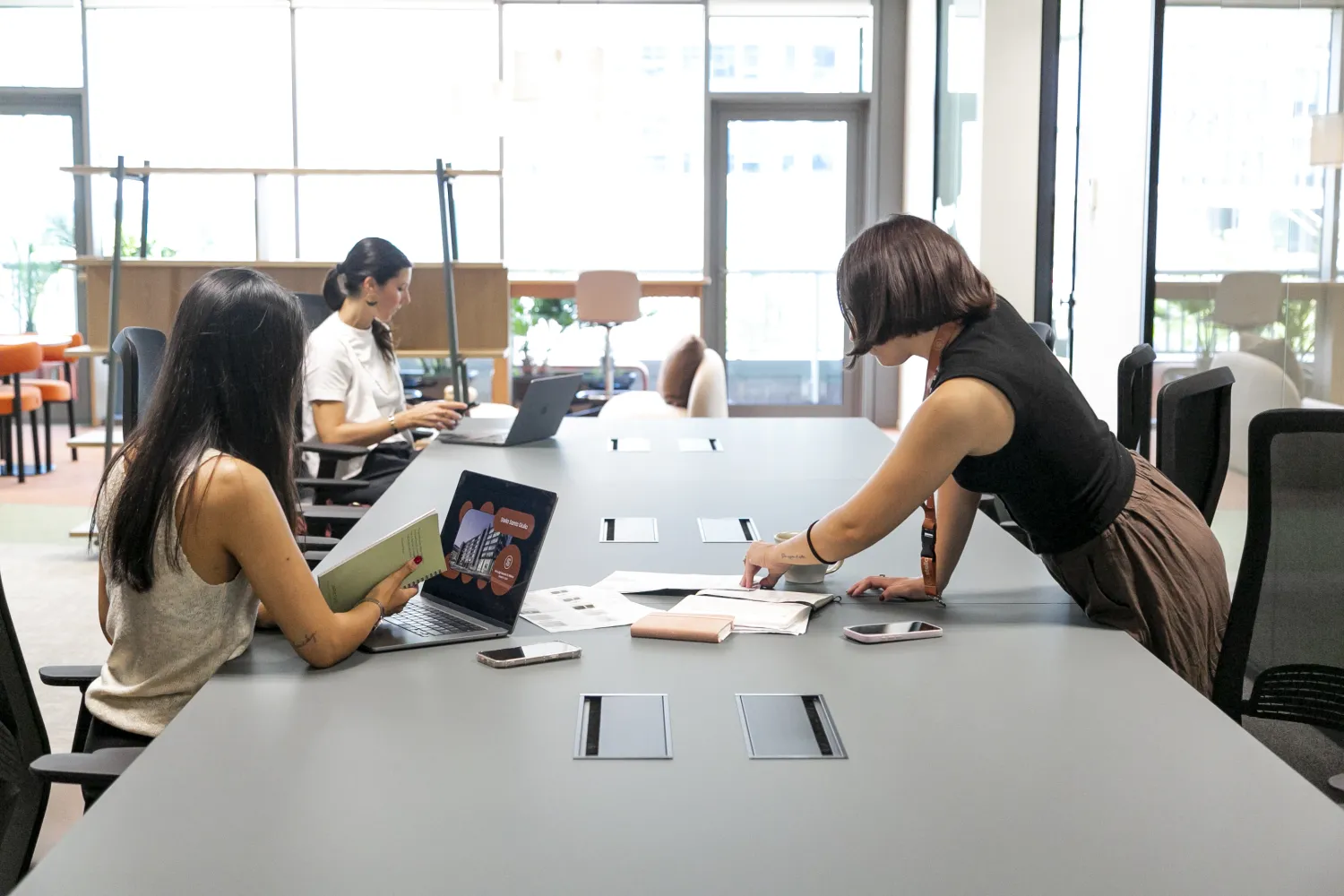
What shaped her perspective on workspace is not simply layout, but functionality. Open spaces, meeting rooms and collaborative areas were designed to enable interaction, creativity and project-based work.
She highlights how usability was critical. Spaces worked intuitively. There was no need for instructions. People could immediately collaborate, brainstorm and create.
In complex, matrix-based organizations, where individuals report to multiple dimensions such as function, geography and project, collaboration is essential. Workspace must support that dynamic.
She also reflects on how, when she entered the workforce, collaborative creativity was becoming central. What once seemed informal or unconventional, like post-it driven sessions, was actually a structural shift in how work was done.
Returning to the office must have a reason
Another key theme is the return to physical presence. For Aram Mbow, especially in consulting environments, presence cannot be imposed. It must be justified.
People return to the office when there is real value in being together. When collaboration is enhanced. When the experience is meaningful and even enjoyable.
She recalls how, after Covid, organizations like Boston Consulting Group invested significantly in making the office desirable again. Not only functional, but also experiential. Spaces were designed to make people appreciate being there as professionals.
This leads to another important concept in her thinking: beauty.
Beauty as a form of care
For Aram Mbow, beauty is not decoration. It is care. She believes that in beautiful spaces, people do better work. But beauty is not only aesthetic. It reflects attention, intention and respect for what people do.
The way we dress, the environments we create, the spaces we inhabit all communicate how much care we bring into our work. In Innovamey’s case, this connects directly to their mission: taking care of the planet, of people and of the systems we are building.
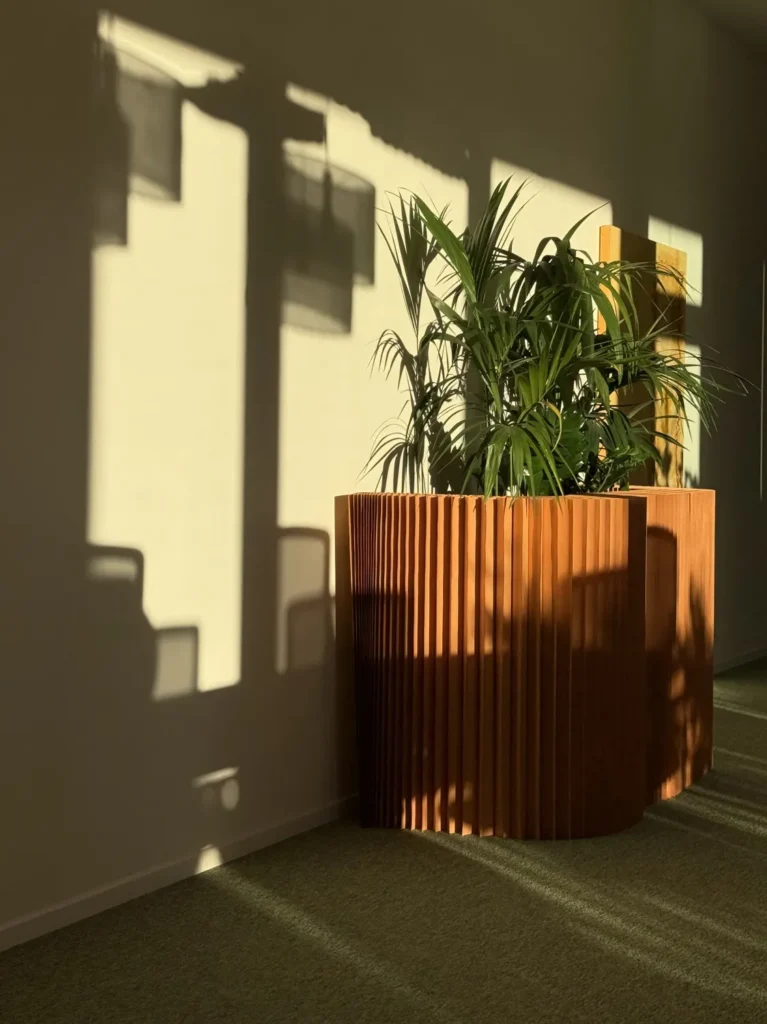
Nature, colors, calmness and overall quality of space contribute to better thinking, stronger relationships and more meaningful outcomes.
Workspace as a relational infrastructure
One of the most original insights from Aram Mbow is that companies have learned to structure financial capital, human capital and technology, but not yet relationships.
And yet, relationships are at the core of everything: business development, talent attraction, investor trust, stakeholder engagement.
In a context where trust in institutions and systems is weakening, relationships become even more critical.
Workspace, in this perspective, becomes a way to make relationships tangible. It becomes a deliberate choice to invest in connection, to give it weight within the business model.
Hybrid work at Innovamey: first how, then where
Innovamey operates with a hybrid model: typically three days in the office and two remote. However, flexibility remains central.
For Aram Mbow, flexibility predates the concept of smart working. Her career has always been mobile, working across locations and contexts without rigid constraints. But again, the key point is not location. It is how work is structured. Just as digital transformation is not about digitizing old processes, hybrid work is not about splitting time between home and office without rethinking collaboration.
Clear objectives, accountability, project-based work and autonomy must come first. Only then does location become meaningful.
At Innovamey, people naturally coordinate their presence because they recognize the value of being together. Collaboration is faster, ideas emerge more easily and overall quality improves. At the same time, individual work remains important. Certain tasks require focus and solitude. And personal life, including family responsibilities, plays a role in how people choose where to work.
Workspace, cost and governance: a design choice
Workspace is also a cost, especially for a growing company. Aram Mbow acknowledges this clearly.
However, Innovamey did not approach this by building everything internally. Instead, they chose to rely on a solution where key elements were already designed effectively.
Ergonomics, sustainability, environmental quality and infrastructure were embedded by design. Recreating the same level of quality independently would have been more expensive and not necessarily more effective.
This reflects a broader principle: critical choices should not depend on momentary decisions or individual preferences. They should be embedded in the system.
In this sense, delegating the governance of workspace is not a loss of control, but a strategic choice.
For Aram Mbow, ESG is not a function. It is innovation
At the core of Innovamey’s vision is a clear statement: ESG, as traditionally framed, is often too disconnected from business.
In her experience, ESG roles in large organizations have rarely driven real strategic change when treated as isolated functions.
Instead, she defines her work as innovation. And in 2026, innovation cannot exist without integrating people, planet and prosperity.
Sustainability is not an add-on. It is the foundation of innovation.
This requires a shift from short-term thinking to long-term responsibility. Companies cannot succeed if the ecosystems around them fail. They cannot grow if their people are not supported. And they cannot operate ignoring the environmental systems they depend on.
Measurement as a starting point
Transformation starts with measurement.
According to Aram Mbow, organizations cannot improve what they do not measure. Measuring emissions, diversity, environmental impact and internal dynamics creates awareness.
Awareness leads to action. Action leads to structured plans. And over time, this generates real value within the organization.
Innovamey supports companies in building this infrastructure: measuring, planning and evolving with a long-term perspective.
When sustainability becomes desirable, it creates value
A critical distinction in her perspective is between compliance-driven sustainability and desirable sustainability.
When ESG is pursued only because it is required, its impact remains limited. When it is understood, shared and embraced internally, it becomes something people believe in.
At that point, communication becomes more authentic, positioning becomes stronger and companies can even capture premium value.
Real estate and sustainability by design
Aram Mbow also shares experiences with clients in real estate and construction.
In one case, a company transitioned towards more sustainable construction practices, not as isolated experiments but as a structured approach. This became part of their identity and positioning.
The result was tangible: access to new tenders, stronger credibility and the ability to win projects that were previously out of reach, such as a Microsoft data center in Greece.
This demonstrates that sustainability, when embedded by design, is not only ethical but economically advantageous.
Shared economy and workspace
Finally, Aram Mbow highlights the role of shared models in the future of workspace.
With increasing pressure on resources and space, the challenge is to use assets more efficiently. Shared environments allow more people to access higher-quality spaces, only when needed.
This does not reduce quality. It can actually increase it, while improving efficiency and reducing total cost of ownership.
A final perspective
Aram Mbow’s vision is clear: workspace matters when it reflects how a company chooses to operate.
For Innovamey, this means integrating sustainability, relationships, flexibility, beauty and measurement into a coherent system. It means designing environments where diversity is expressed, collaboration is natural and sustainability is embedded by design.
In this sense, workspace is no longer just a place. It is a statement of intent.
The Innovamey case originates from a direct conversation between Pietro Martani and Aram Mbow, founder of the company, as part of the Limitless Workspace interview series.